You’ve nailed the PLG funnel.
Thousands of users embark on your website on the “Start for free” journey. You’re already enriching and routing the perfect Ideal Customer Profile (ICP) to sales reps, while the rest go through automated nurturing sequences. That’s standard for a mature product-led machine.
Now comes the next growth lever: going up-market and winning the accounts that aren’t actively shopping for you. The only way to reach them, without killing the self-serve engine, is outbound that’s powered by the same data your PLG motion runs on.
Here are the top 3 plays you should start with to start layering systematic outbound.
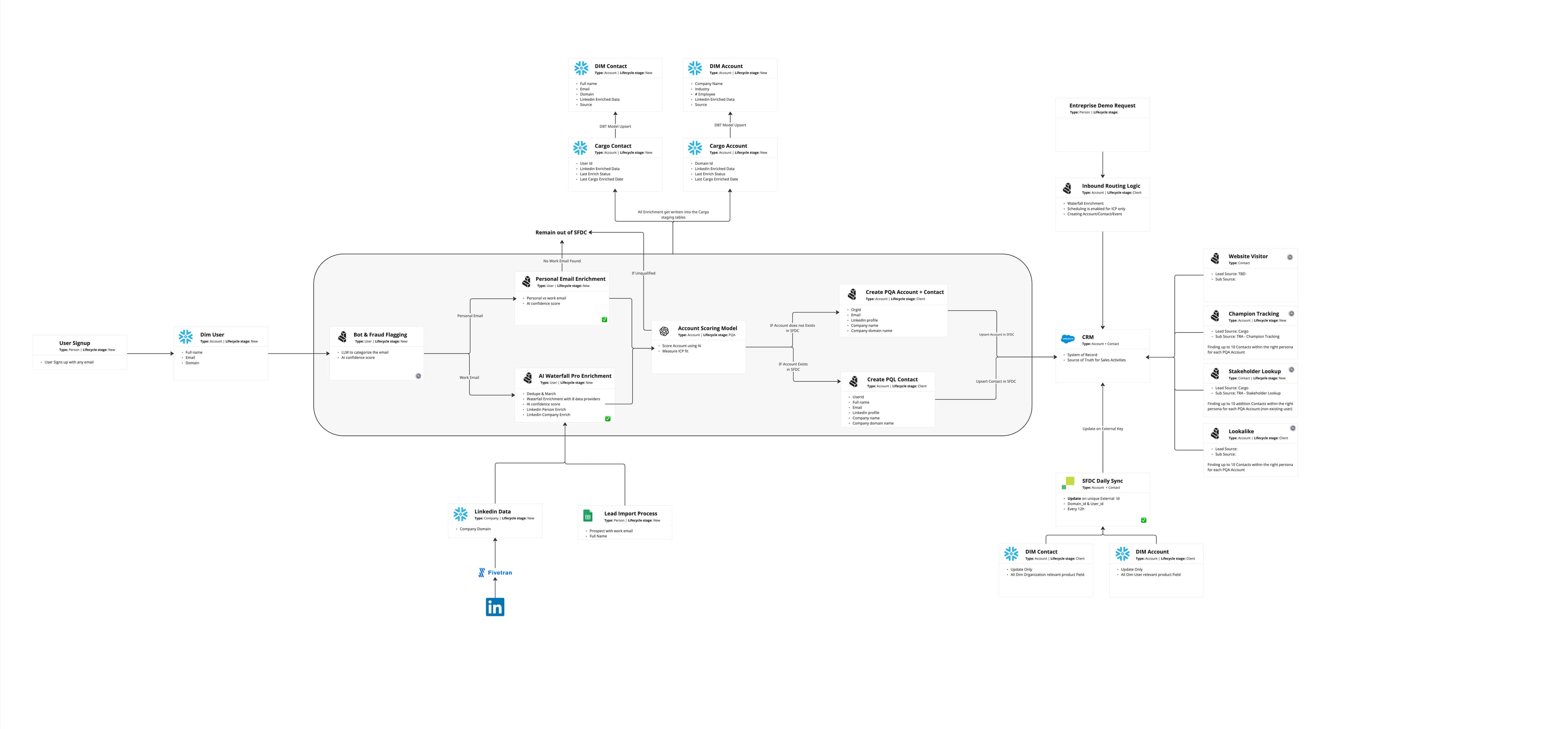
Let’s start with the simplest, highest-leverage play: cloning your best existing customers.
Lookalike: Clone Your Best-Fit Customers from Self-Serve #
It starts simple: take a Tier-1 customer you’ve already won and clone it.
Your best logos are the blueprint for your next ones. This workflow enables you to automatically generate lookalikes of your Tier-1 accounts (exact same kind of companies), fully enriched with the right buyers, allocated to your sales reps.
This isn’t an ad hoc silver bullet. You close another logo. The engine refreshes itself, so outbound stays sharp, compounding, and always anchored to reality.
How It Works in Cargo
- Trigger: Closed-won accounts automatically enrolled in the workflow
- Generate: Up to 50 lookalikes per customer
- Enrich: The right stakeholders and contact data
- Auto-assign: The accounts to the closing AE (my recommendation) or you can round-robin across territories
- Route: Stakeholders to the right sequence (decision makers to high-touch sequence, end users and influencers to self-serve)
This creates a self-sustaining engine that generates new target accounts every time you close a customer, a true outbound flywheel.
Descript doubled rep-initiated pipeline in 15 days using this loop.
List building is like manual data entry in your CRM. It should not exist anymore.
Once you’ve systematized replicating your ideal customers, your next easy win is to leverage your existing user base, specifically when your champions switch jobs.
Track Your Champions’ Job Changes #
In this section, we’ll use “champions” to refer to buyers, influencers, or end users who change companies.
The unfair advantage of PLG companies is the volume of users they have.
Just think about how many champions companies like Cursor, Figma, and Loom have. They are your trojan horse to penetrate new accounts.
Of course, you want to prioritize tracking buyers, as they possess the buying power necessary to secure a “company-wide deal.” But you can then expand to any engaged users that changed companies.
The main difference in outreach depends on whom you are contacting.
If you’re reaching out to a buyer, you should request a meeting to discuss a business deal.
If you’re contacting an end user, you should ask for an introduction to the decision-maker or encourage them to promote the usage of your product within their team (giving discounts, company swag, etc.).
Once you have established usage, you can then reach out to the decision-makers, stating: “We already have 10 people from [COMPANY] using our product. You could benefit from this bundle, etc.”
How It Works in Cargo
- Trigger: Start from a table in your data warehouse of “deactivated users” (this is the best way to know when to start tracking a champion move)
- Listen: For LinkedIn profile updates (ensures timely outreach)
- Update: When the job change happens, we’ll upsert the new contact to CRM (create the company if not existing), and mark the old contact as “archived” or even better use a specific object (like related contact in Salesforce)
- Allocate: To the previous account owner in your CRM
- Notify: Slack notification “Champions moved”
Gorgias booked $950k of expansion pipeline last quarter from job-hop signals alone.
Champion tracking is the only evergreen, industry-agnostic signal that works universally, because it’s based on people who’ve already experienced your product.
Now that you’re tracking champions who’ve moved, there’s one more untapped source hiding in plain sight: the high-intent enterprise visitors quietly exploring your site.
Website Visitors: High-Intent Leads Visiting Your Website #
If your site gets 300K+ monthly visits, you may want to focus on high-intent pages, broad tracking may be too costly.
Your self-serve funnel captures plenty of leads but not everything. Given the high traffic volume most PLG companies have, you necessarily have some enterprise deals that won’t be ready to “self-onboard” on your product.
This is where website visitor tracking comes in.
These hidden, high-intent visitors already know your product, match your ICP, and could become your next big enterprise logos.
The idea here is to nurture those leads with relevant content, or if already demonstrating high intent (like checking pricing pages or documentation without signing up), you can allocate them to sales reps.
You should target a reveal-to-meeting rate ≥3% and first touch SLA within 24 hours.
How It Works in Cargo
- Trigger: Use Snitcher natively in Cargo or connect to Clearbit, Albacross via webhook
- Filter: Only on ICP companies using AI or via a scoring model
- Score (Optional): Create a quick scoring to assess intent (based on page views)
- Enrich: Retrieve and enrich the right stakeholders in those organizations automatically
- Push: To nurturing sequence that is a mix of sales touchpoints and relevant marketing content based on their website behavior
Datadome plugged RB2B with Cargo and generated $1M+ in fresh pipeline in the first two weeks.
By layering outbound atop your PLG foundation, you’ve created a growth flywheel: turning website visitors into enterprise pipeline, cloning your best customers systematically, and leveraging champions’ job changes into new accounts.
Now you’re equipped, time to put these workflows into action.
Key Takeaways #
- Once PLG is nailed (enriching/routing ICP to reps, nurturing rest), layer outbound to go up-market: Win accounts that aren’t actively shopping for you using same data PLG runs on, 3 systematic plays: Lookalike (clone best customers), Champion tracking (job-hop signals), Website visitors (high-intent enterprise browsing without signup)
- Play #1, Lookalike: Self-sustaining engine that clones Tier-1 wins: Closed-won account → auto-generate 50 lookalikes → enrich stakeholders → auto-assign to closing AE or round-robin → route by persona (decision makers → high-touch, end users → self-serve). Result: Descript doubled rep-initiated pipeline in 15 days
- Play #2, Track champions’ job changes: PLG’s unfair advantage is user volume: Trojan horse to penetrate new accounts. Trigger: Deactivated user → listen for LinkedIn profile update → upsert new contact to CRM, archive old → allocate to previous AE → Slack notify. Gorgias: $950K expansion pipeline last quarter from job-hop signals alone
- Play #3, Website visitors: High-intent enterprise exploring without signup: 300K+ monthly visits = hidden enterprise deals won’t self-onboard. Trigger: Snitcher/Clearbit/Albacross → filter ICP via AI/scoring → score intent (page views) → enrich stakeholders → push to nurture (sales touchpoints + relevant content). Datadome: $1M+ pipeline in first 2 weeks
- Outbound becomes a flywheel when layered atop PLG foundation: Every closed deal generates new lookalikes (compounding), every champion move creates new account entry (evergreen), every website visitor surfaces hidden intent, automation + data orchestration = growth engine that runs itself
Frequently Asked Questions #
Start layering outbound when you’ve nailed the PLG foundation: thousands of signups flowing, ICP-fit leads enriched and routed to reps automatically, non-ICP in automated nurture sequences, and self-serve conversion machine running smoothly.
Why then? You’ve proven product-market fit, have data on who your best customers are (ICP definition), and built orchestration infrastructure (enrichment, scoring, routing). Now you can systematically go up-market, target enterprise accounts that won’t self-onboard, expand TAM beyond “active shoppers,” and leverage your existing user/customer base as a growth lever.
Don’t layer outbound too early (pre-PMF, unclear ICP) or you’ll waste rep time on wrong accounts. Don’t wait too long or competitors will capture up-market accounts first.
Traditional list building = manual, one-time, static. Lookalike engine = automated, continuous, compounding.
How it works:
- Closed-won Tier-1 account auto-triggers workflow
- Generate 50 lookalike companies (same industry, size, tech stack, growth stage)
- Enrich all relevant stakeholders at those accounts (decision makers, influencers, end users)
- Auto-assign to the closing AE (they know what works for this customer profile) or round-robin by territory
- Route by persona: Decision makers → high-touch sequence (personal outreach), End users → self-serve (product trial encouragement)
Why it compounds: Every win creates 50 new target accounts automatically. Close 10 Tier-1 deals this month? → 500 fresh, highly-targeted accounts next month. Your best customers continuously define who to target next, always anchored to reality, never stale lists.
Result: Descript doubled rep-initiated pipeline in 15 days.
Champions = buyers, influencers, or end users from your existing base who’ve changed companies. PLG companies have thousands of users, your trojan horse for new account penetration.
Process in Cargo:
- Trigger: Start from “deactivated users” table in warehouse (best signal someone left)
- Listen: For LinkedIn profile updates (ensures timely outreach vs. batch checks)
- Update: When job change detected → Create new contact at new company in CRM, archive old contact (or use “Related Contact” object in Salesforce to maintain history)
- Allocate: To previous account owner (already has relationship)
- Notify: Slack alert “Champion [NAME] moved to [NEW COMPANY]”
Outreach strategy:
- Buyer champion: Request meeting to discuss business deal (“You drove success at [OLD COMPANY], let’s bring [PRODUCT] to [NEW COMPANY]”)
- End user champion: Ask for intro to decision-maker OR encourage team adoption (offer discount, swag). Once 10+ users, approach decision-maker: “Already have 10 people from [COMPANY] using [PRODUCT], here’s enterprise bundle”
Result: Gorgias booked $950K expansion pipeline last quarter from job-hop signals alone. Evergreen, industry-agnostic signal.
Problem: High-traffic PLG sites get enterprise accounts exploring (browsing docs, pricing) but NOT signing up (won’t self-onboard). Traditional approach = ignore them or force signup. Better approach = targeted outbound nurture.
Process:
- De-anonymize: Use Snitcher (native in Cargo), Clearbit Reveal, Albacross, or RB2B to identify company behind anonymous visitor
- Filter ICP: Only target companies matching ICP (use AI or scoring model, if 300K+ monthly visits, focus on high-intent pages only to avoid cost explosion)
- Score intent (optional): More page views + pricing/docs pages = higher intent
- Enrich stakeholders: Find decision makers, champions at that company automatically
- Nurture: Push to mixed sequence (sales touchpoints from AE + relevant content based on pages viewed)
Target metrics: ≥3% reveal-to-meeting rate, < 24hr first touch SLA.
Result: Datadome plugged RB2B with Cargo, generated $1M+ pipeline in first 2 weeks. Hidden high-intent enterprise deals that would’ve walked away.
Traditional outbound: Static lists, one-time campaigns, manual research, disconnected from PLG data. Reps build lists quarterly, blast sequences, lists go stale, repeat.
Outbound flywheel (layered on PLG): Automated, continuous, self-reinforcing loop powered by same data as PLG motion.
Flywheel dynamics:
- Lookalikes: Every win creates 50 new targets automatically (compounding)
- Champion tracking: Every deactivated user becomes potential entry to new account (evergreen source)
- Website visitors: Every high-intent visitor surfaces hidden enterprise opportunity (leverages existing traffic)
Why it’s a flywheel: Each play feeds the others. Website visitor converts → becomes customer → generates lookalikes. User becomes champion → job-hops → new account → that account’s team becomes users → more champions. Growth compounds at every stage, runs on autopilot via orchestration, always fresh (no stale lists).
PLG foundation provides data/infrastructure, outbound layer systematically captures accounts that won’t self-serve.
 MaxApr 30, 2025