Warehouse-First System of Engagement: Why the Future is Data-Native Operations
 Aurelien
Part 2 of 2: Systems of Engagement Series
In Part 1, we explored why traditional CRM-centric engagement is broken. Now we’ll dive into the architecture that’s replacing it: warehouse-first systems of engagement.
Tomorrow’s System of Engagement #
Now, listen up: question for you guys!
Why do we have software in Business Intelligence that sits directly on top of the data warehouse (👋 Hello Looker or Metabase) and, on the other side, we are still using API or reverse ETL to sync data back to our (siloed) operational tools?
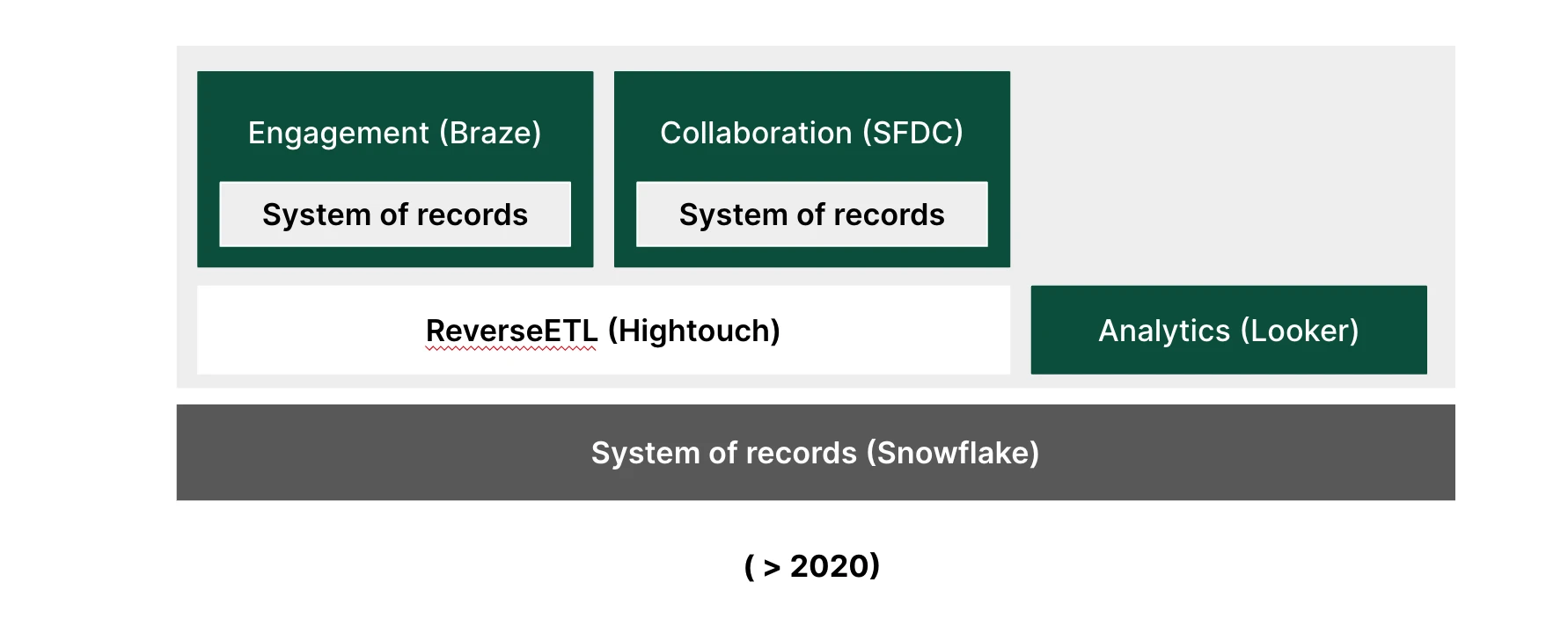
You might be wondering what’s wrong with API sync & reverse ETL?
To answer shortly, try to sync 6 million customer records daily to keep your CRM up to date, and check your invoice at the end of the month. Unfortunately, there is an inefficiency in the way we treat data today.
The Duplicate Data Cost Problem #
The real question is “why should we pay multiple times for the same data?”
As most SaaS are record-based, you need to pay for this customer record in Braze, in Intercom, in Zendesk, in Hubspot, basically in every go-to-market and customer support application. Each tool stores a copy of your customer data in its proprietary system.
Cloud-based storage is cheap. Storage inside of SaaS tools … is not
Isn’t that crazy?

The Economics of Duplicate Data
Let me give you two analogies:
For engineers: If you have multiple times the same lines of code in your script, you did not factorize well and can write code more efficiently.
For marketers: In a landing page, if you have several blocs answering the same need, it means you can craft a better persuasive flow. You should not have repetition/duplicate blocs.
If you agree with this, you should not pay “duplicated cost” for the same record.
I won’t discuss other limitations around data security and observability by pushing your data to an external platform.
The Warehouse-First Architecture #
On the benefits side, beyond getting a common single source of trust, data and revenue teams would enjoy specific advantages:
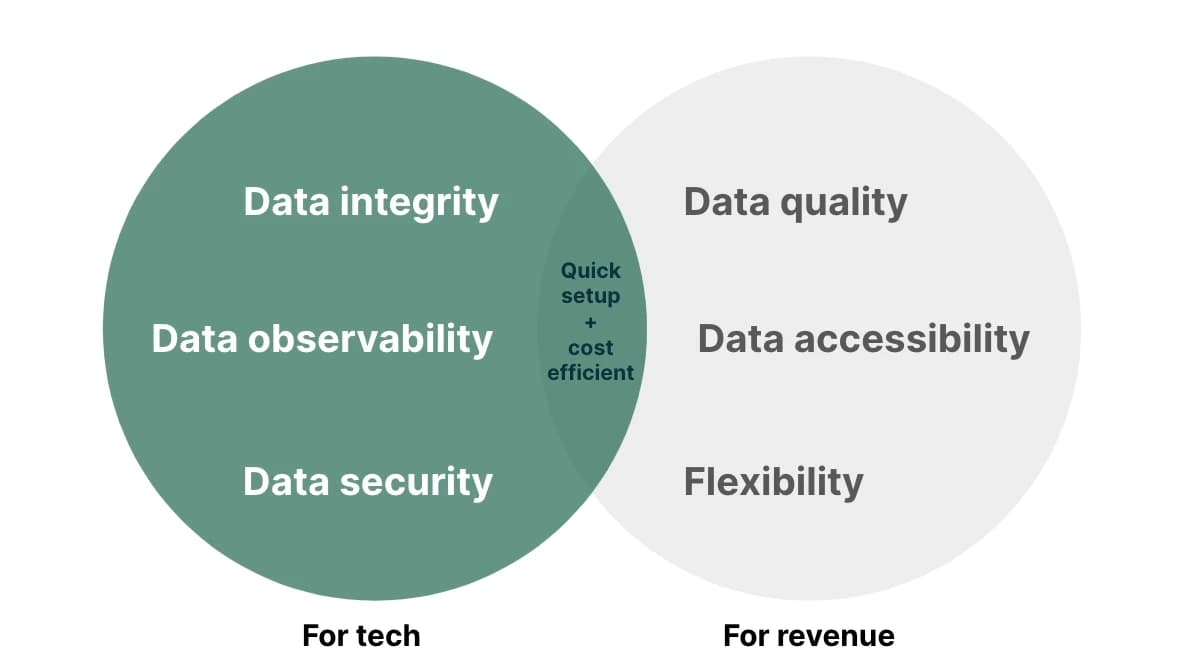
For Data Teams:
- Data integrity: Engineering team ensures that data are reliable
- Data Observability: Enterprise-grade control provided by modern cloud data warehouse to control and govern access
- Data Security: You won’t have a third party storing your data
For Revenue Teams:
- Data accessibility: No more bottleneck to leverage CDWs power
- Flexibility: You can leverage custom business definitions and entities
- Data quality: Orchestrate campaigns or operation processes on reliable data
- Cost efficient: You don’t pay multiple times for the same data
Why Haven’t We Replicated Looker’s Success for Operations?
Why haven’t we been able to replicate Looker’s success in business intelligence (BI) for data operationalization?
By data operationalization, we mean ensuring that accurate and timely data is made available to systems that can use it to drive action, such as in advertising, product usage monitoring, customer engagement, and sales automation.
This is where Cargo comes in: We are the application layer on top of where your data lives: the data warehouse.
As CDWs are now considered the reliable source of truth for modern companies, we need to build the missing piece: software built from the ground up to leverage data warehouse power and bring business folks, the biggest data consumers, on top of this new source of truth to let them orchestrate campaigns and build operation processes.
It will also help unite data and business teams to build applications that drive revenue using the same source of truth.
✔️ According to Sirius Decision, B2B businesses that align their revenue engine grow 12X to 15X times faster than their peers and are 34% more profitable.
No more siloed and disparate data, no more internal battle with each department claiming to have different data.
Welcome to the world of alignment and performance.
How Warehouse-First Architecture Works #
Instead of the traditional approach:
- Extract data FROM warehouse
- Sync TO operational tools via API/Reverse ETL
- Each tool stores a copy
- Pay for storage N times
- Deal with sync delays and conflicts
The warehouse-first approach:
- Data stored ONCE in warehouse (Snowflake, BigQuery, Databricks)
- Engagement layer (Cargo) queries warehouse DIRECTLY (like Looker for BI)
- No data duplication
- Real-time access to source of truth
- Write actions/outcomes back to warehouse
- Activate to downstream tools only when needed
The Four Layers
Layer 1: Warehouse (System of Record)
- All data stored once (Snowflake, BigQuery, Databricks)
- Raw data from all sources (CRM, product, support, marketing, finance)
- Single source of truth for all GTM data
Layer 2: Semantic Layer (Business Context)
- Built with dbt (data build tool) to transform raw data into business entities
- Defines what “Customer”, “Account”, “High-Intent Lead”, “At-Risk Customer” mean for YOUR business
- Consistent business logic and metrics (ICP scoring, health scores, engagement metrics)
- Creates a shared language between data teams and revenue teams
- This is the key enabler: Without semantic layer, you’re stuck with vendor schemas (Salesforce’s Lead/Contact/Account objects)
Why the semantic layer matters: Your business doesn’t fit Salesforce’s schema. You might have “Workspaces”, “Teams”, “Donations”, or other custom entities. The semantic layer lets you define YOUR business model in the warehouse, and all downstream operations (workflows, AI agents, reporting) consume these definitions.
Layer 3: Engagement Layer (Application)
- Queries warehouse + semantic layer directly (no data copy)
- Provides no-code UI for GTM teams to build on top of business entities
- Enables workflows, scoring, routing, orchestration using YOUR definitions
- Writes results back to warehouse (actions, outcomes tracked)
Layer 4: Operational Tools (Activation)
- CRM (Salesforce, HubSpot): Where decisions are recorded
- Sales engagement (Outreach, Salesloft): Where sequences execute
- Email/Slack: Where alerts are sent
- Data flows one-way: Warehouse → Tools (not both ways)
The Economics: Real Numbers #
Let’s compare costs for a typical mid-market B2B SaaS company with 100K customers:
Traditional CRM-Centric Stack:
- 80+ SaaS tools × 480K/year
- API integrations maintenance = $90K/year
- Sync costs (Census/Hightouch) = $60K/year
- Duplicate data storage: 100K customers × 7 tools = 7x storage cost
- Total: $630K/year (just for data infrastructure)
Warehouse-First Stack:
- Snowflake compute/storage = $24K/year (100K customers stored once)
- Warehouse-native apps (Cargo) = $60K/year
- Reduced SaaS tools (only need 20-30) = $150K/year
- Total: $234K/year
Savings: $396K/year (63% reduction) + faster operations + better data quality
Key Takeaways #
- Warehouse-first architecture eliminates duplicate data costs: Traditional: Pay for same customer record in Salesforce, Braze, Intercom, Zendesk, HubSpot (7x storage). Cloud storage cheap (thousands/mo). Warehouse-first: Data stored once, engagement layer queries directly (no copy), zero duplication. Savings: 63% cost reduction ($396K/year for typical mid-market company).
- Four-layer architecture: Warehouse → Semantic Layer → Engagement → Tools: Layer 1 (Warehouse): All raw data stored once in Snowflake/BigQuery. Layer 2 (Semantic layer): dbt models define YOUR business entities, metrics, logic (not vendor schemas). Layer 3 (Engagement): Cargo queries semantic layer for operations. Layer 4 (Tools): CRM, sales engagement for execution. The semantic layer is critical, it lets you define your business model (workspaces, teams, ICP scoring) once, and all downstream operations consume these consistent definitions.
- Benefits for Data teams: Security, integrity, observability: Data stays in your controlled environment (GDPR/HIPAA compliant), engineers ensure reliability via dbt models/tests, enterprise-grade governance via warehouse (audit logs, query history, lineage), no third parties storing customer data.
- Benefits for Revenue teams: Accessibility, flexibility, quality: Self-serve on warehouse data via no-code UI (no engineering bottleneck), use custom business entities (workspaces, teams, donations, not vendor schemas), build campaigns on reliable, governed data (not stale CRM copies), companies aligning revenue engine grow 12-15x faster (Sirius Decision).
Frequently Asked Questions #
Record-based SaaS pricing model: You pay per customer record in each tool. 100K customers? Pay for 100K records in: Salesforce (CRM), Braze (engagement), Intercom (support), Zendesk (ticketing), HubSpot (marketing), Segment (CDP), Snowflake (warehouse). Same 100K customers, 7x storage cost.
Cloud storage is cheap, SaaS storage is expensive: Storing 100K records in Snowflake = ~thousands/month (each has per-record pricing). You’re paying 100x+ for duplicate data.
Sync costs compound: APIs/Reverse ETL charge per row synced. Update 6M records daily to keep CRM fresh? Expensive API calls + compute costs. Census/Hightouch charge based on rows synced per month.
Analogy: Like copy-pasting same function across 10 files instead of factorizing into one reusable function. Inefficient, expensive, error-prone (updates must cascade to all copies).
Architecture shift: Instead of extracting data FROM warehouse → syncing TO operational tools (each storing copy), the engagement layer queries warehouse DIRECTLY (like Looker does for BI).
Warehouse = System of Record (single source of truth):
- All data stored once (customer, product, sales, marketing, support)
- Data engineers ensure integrity, observability, security via dbt + warehouse governance
- Custom business entities (your schema, not vendor’s)
Cargo = System of Engagement (application layer on warehouse):
- Queries warehouse directly (no data copy)
- Provides no-code UI for GTM teams to build workflows (sequences, scoring, routing, orchestration)
- Writes results back to warehouse (actions, outcomes tracked in unified system)
- Activates to downstream tools (CRM, email, ads) only when needed
Benefits: Zero duplication cost (pay for storage once), zero sync delays (real-time queries), complete data ownership, flexible schemas, enterprise security.
The semantic layer is the business logic layer between raw warehouse data and operations.
What it is: Built with dbt (data build tool), the semantic layer transforms raw data tables into business entities and metrics that match YOUR business model, not vendor schemas.
What it defines:
- Business entities: “Customer”, “Account”, “Workspace”, “Team” (your definitions)
- Business metrics: “ICP Fit Score”, “Engagement Score”, “Health Score”, “ARR”, “Pipeline Coverage”
- Business logic: “What makes a lead high-intent?”, “When is a customer at-risk?”, “What’s an expansion opportunity?”
Why it’s critical: Without semantic layer, you’re forced to use Salesforce’s Lead/Contact/Account schema or HubSpot’s object model. Your business doesn’t fit their boxes. The semantic layer lets you define YOUR business model once in the warehouse, and all downstream operations (Cargo workflows, BI dashboards, AI agents) consume these consistent definitions.
Example: Instead of querying 5 raw tables (events, accounts, users, payments, support_tickets), your “high_intent_leads” dbt model joins them and defines the logic once. Cargo, Looker, and AI agents all consume the same “high_intent_leads” definition, no duplicate logic, no inconsistencies.
Benefit: Data teams own definitions (governance, quality), revenue teams consume them (self-serve, no engineering bottleneck).
Keep these tools (they provide unique value beyond data storage):
- CRM UI: Salesforce/HubSpot for deal/pipeline management interface (but warehouse is source of truth)
- Sales engagement: Outreach/Salesloft for email sequencing execution (Cargo triggers, they execute)
- Marketing automation: Braze/Iterable for omnichannel messaging orchestration
- Support ticketing: Zendesk/Intercom for ticket management UI
Replace these tools (they’re just duplicate data storage):
- CDPs: Segment/mParticle (warehouse is your CDP)
- Reverse ETL: Census/Hightouch (warehouse-native apps query directly)
- Data enrichment: Clearbit/ZoomInfo (enrich in warehouse once, not per tool)
New tools to add:
- Warehouse-native apps: Cargo for operations, Omni/Hex for BI
- dbt: For data transformations and business logic layer (semantic layer)
Continue the Series #
Part 1: What is a System of Engagement?
Learn the foundational concepts. Understand what systems of engagement are and why traditional CRM-centric engagement is broken.
Complete Guide
Read all three parts in one comprehensive resource. The complete journey from CRM-centric to AI-powered revenue operations.
AurelienDec 14, 2025