CRMs are no longer seen as the definitive source of trust for enterprises in collecting customer data. Instead, it has become just another SaaS tool that cannot handle the complex data architectures that modern enterprises have created.
Warehouses have emerged as the new system of record, revolutionizing how we approach data management. As a result, the CDW industry has grown from 80B in the last 5 years. One of the main benefits of a data warehouse is its flexibility, security, and ability to grow with your business.
Several apps have realized the true potential of data warehouses and have harnessed their power by building on top of them, enabling business applications to go beyond just business intelligence.
What are the benefits of data warehousing? #
In the last 5 years, the number of SaaS tools used by companies has been multiplied by 10.
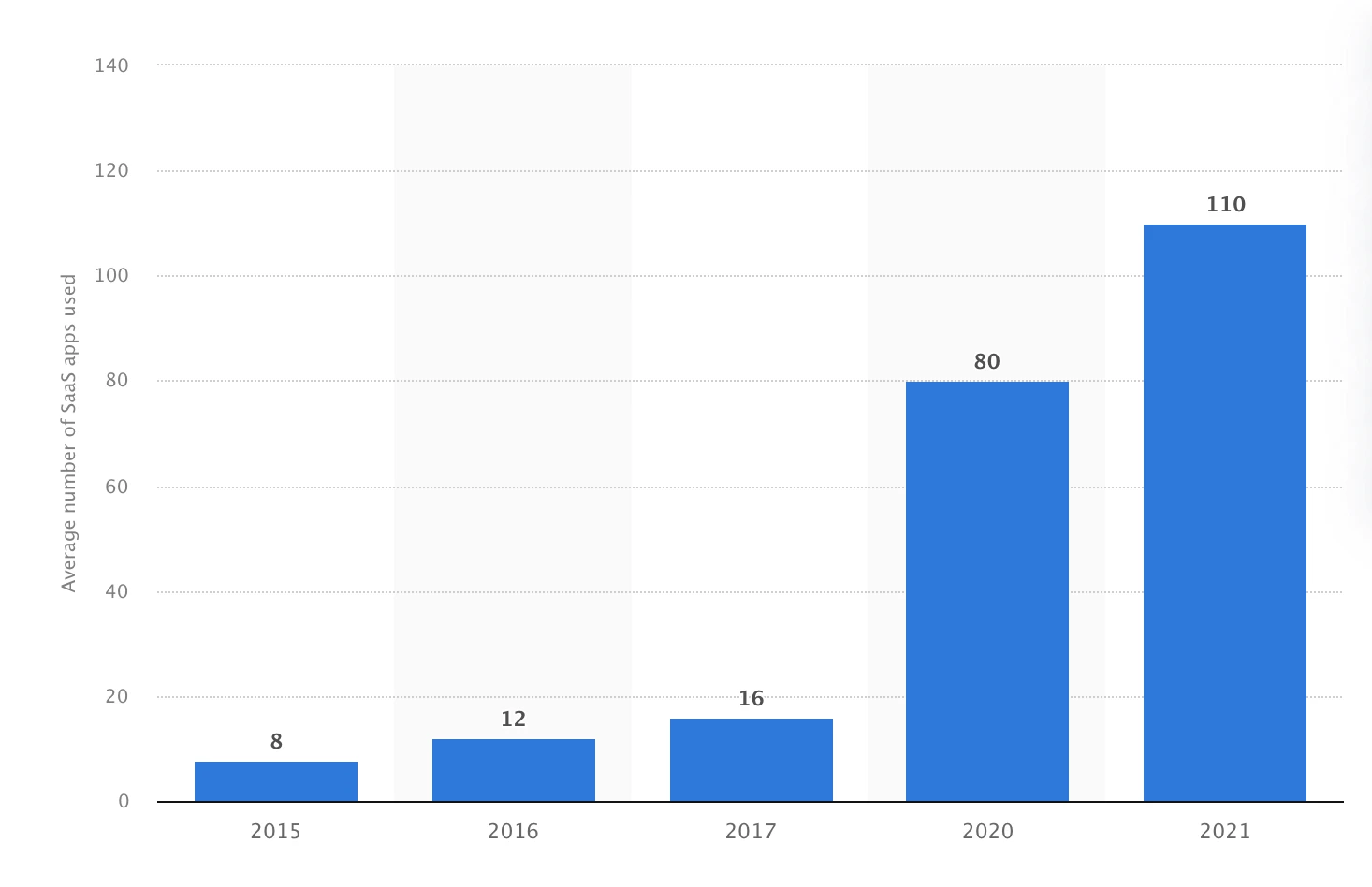
To face the ever-growing complexity and volume of their data, businesses are increasingly adopting data warehouses as their source of truth and shifting to modern data stack technologies.
It helps organizations to centralize and manage large amounts of data from various sources, such as transactional databases, log files, and external data sources (i.e., third-party tools).
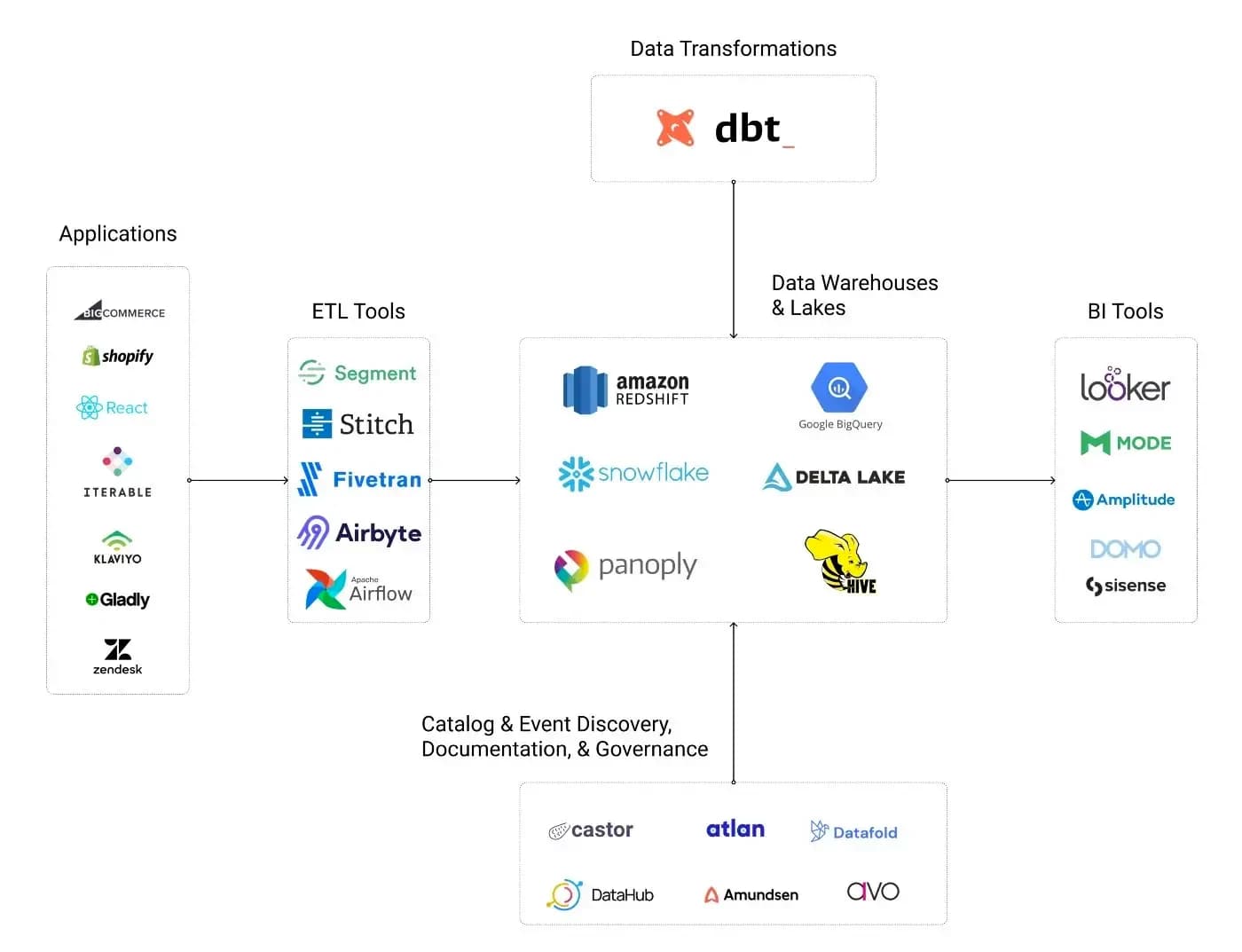
Some specific benefits of data warehousing include:
-
Improved data access: Data warehousing provides a single, centralized repository for data from various sources, making it easier for users to access and analyze the data.
-
Enhanced data quality: Data warehousing helps to ensure the quality and integrity of the data by enforcing data standards, performing data cleansing, and providing a consistent view of the data.
-
Increased efficiency: Data warehousing enables users to access and analyze data faster, as the data is pre-processed and organized in a structured format. This can help to reduce the time and resources required to perform data analysis.
-
Improved decision-making: Data warehousing provides a comprehensive view of an organization’s data, enabling users to identify trends, patterns, and relationships that may not be apparent in individual data sources. This bring more data and less bias to the process.
What are the most common data warehouse applications? #
There are several common applications of data warehousing, including:
-
Business intelligence: Data warehousing is often used to support business intelligence (BI) and reporting activities. Modern BI tools like Looker or Metabase sit directly on top of the warehouse, enabling businesses to get insights faster and to drive the company with a data-driven approach, not intuition
-
Operations: Data warehousing enables organizations to perform advanced analytics, such as data mining, scoring, and predictive modeling, on large datasets. This can help organizations identify trends, patterns, and relationships in the data that can optimize business processes and improve decision-making.
-
Customer segmentation: Data warehousing can segment customers based on their characteristics and behavior, enabling organizations to tailor marketing campaigns and other initiatives to specific groups of customers. The 360° view of the customer we’ve all dreamt about is finally here!
What is a data warehouse native app? #
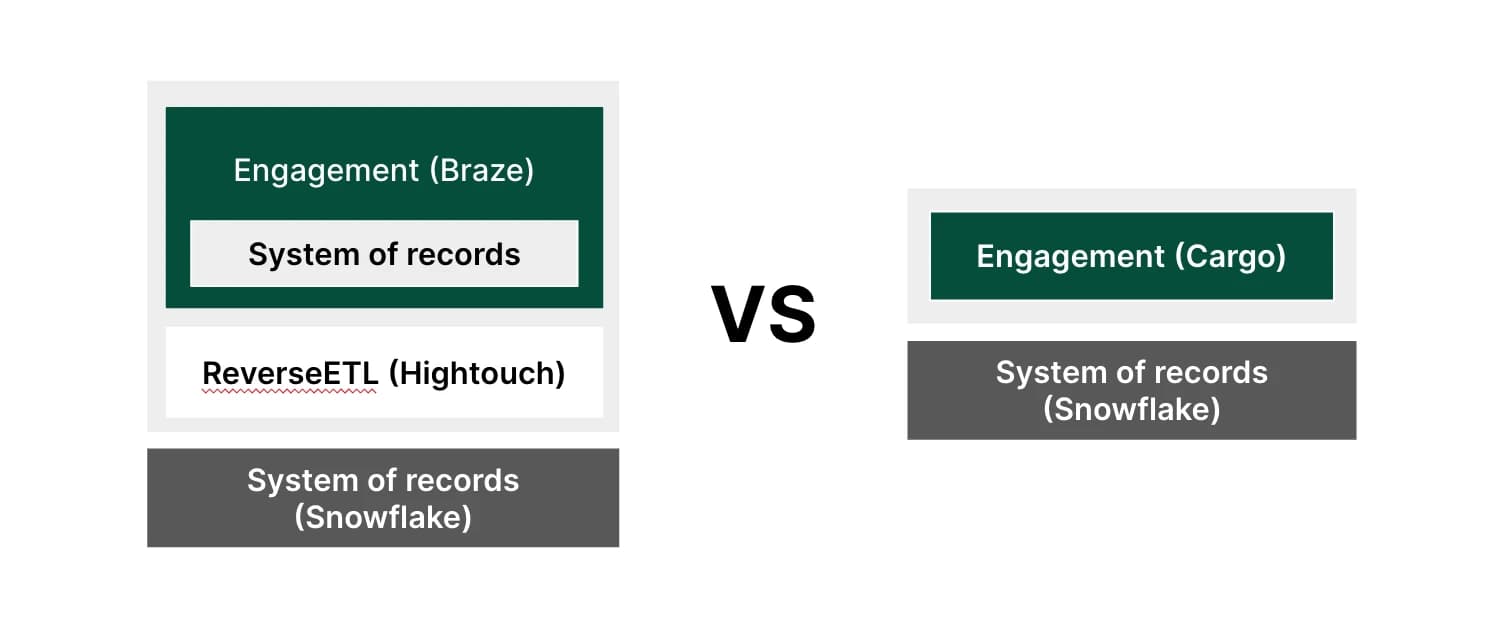
They are software applications that do not have their own data backend and are just an application layer on top of your company data. Therefore, there is no need to set new data pipelines to sync data to your destination app. They are optimized for working with large amounts of data and custom business entities.
These applications are used for data analysis and reporting and more recently, for orchestrating sales processes and customer engagement.
Different arenas of tools understand the potential of this new generation of SaaS and start leveraging the CDW for specific use cases. Some example includes the BI tools that were initially among the first to do it or, more recently, tools like Pocus in the PLG industry.
What are the benefits of data warehouse native apps? #
Well, one of the most significant advantages is that the data doesn’t need to be synced or replicated on the vendor’s application, which is typically the case with traditional SaaS solutions.
We shouldn’t have to pay for the same data multiple times. We should be able to get it once and use it without paying more. Or I hope you don’t have 100 tools 😅
Another advantage of these apps is that they don’t have ownership of your data because they don’t replicate it. This means you have complete control over your data, as well as enhanced:
-
Observability: The current model of transferring data to a third-party system is problematic because it completely removes visibility and the ability to trace dependencies within the pipeline.
-
Security: You own your data and you keep it in an environment you can control.
-
Cost efficiency: Around 75% cost reduction compared to the sync cost of pushing your data to an external platform (+ Most of the SaaS tools today make you pay “record-based,” so again, you end up paying multiple times for the same data). With CDW native apps, you don’t have to replicate your data.
They take advantage of the data warehouse’s greater accessibility, reliability and integrity to help bridge the gap between data teams and business folks. Data engineers ensure data quality, business folks leverage it to drive revenue.
Ultimately, you don’t have to be tied to a fixed schema. Instead, you can create and own your data models & business entities definition.
Introducing Cargo: The engagement system on top of your data warehouse #
As we said earlier, several tools leverage the data warehouse’s power. Those are idiosyncratic software having a standalone approach, they are still opinionated, so you need one tool for each use case.
Conversely, at Cargo, we are unopinionated by design - Opinionated by usecases.
Cargo lets mature organizations build their internal go-to-market apps on their own, fully customizable and more effective in tackling their use cases.
Those mid-market & enterprise companies deal with high volume and ever-growing complexity of data. By sitting on top of their warehouse, we make it easy to build applications that answer their business-specific needs.
The primary use case today for enterprise companies is lifecycle marketing, like sending a personalized promotional email to a specific segment and building nurturing automation based on user behaviors.
For mid-market and SaaS companies, so far use cases are building an account scoring or churn scoring system and doing lead routing according to their territories and rules.
Key Takeaways #
- Data warehouse native apps = application layer without data backend: Apps built on top of customer’s warehouse, no data replication/syncing required, optimized for large datasets and custom business entities, shift from “data moves to app” to “app moves to data”
- CDW industry grew from 80B in 5 years as warehouses became new system of record: CRMs can’t handle complex modern data architectures (10x SaaS tools in 5 years), warehouses provide centralized, flexible, secure, scalable solution for all customer data
- Three killer advantages over traditional SaaS: Observability (full visibility into data pipelines, dependencies traceable), Security (you own data in environment you control), Cost efficiency (75% reduction vs. sync costs, no paying “per record” to multiple vendors for same data)
- Traditional SaaS = opinionated + proprietary schemas; Warehouse-native = bring your own data model: No vendor lock-in, create and own business entities definitions, bridge gap between data engineers (build quality) and business teams (drive revenue)
- Examples emerging across categories: BI tools (Looker, Metabase), PLG analytics (Pocus), revenue orchestration (Cargo), Cargo is “unopinionated by design, opinionated by use case” enabling custom GTM apps (lifecycle marketing, scoring, routing) on warehouse foundation
Frequently Asked Questions #
A data warehouse native app is software that doesn’t maintain its own data backend, it’s an application layer built directly on top of your company’s data warehouse (Snowflake, BigQuery, Redshift). Instead of extracting/replicating your data to the vendor’s database (traditional SaaS model), the app queries and writes directly to your warehouse. The vendor provides the UI, business logic, and workflows, but all data stays in your environment. Examples: Modern BI tools like Looker (queries warehouse directly), PLG analytics like Pocus (reads product usage from warehouse), revenue orchestration like Cargo (builds workflows on warehouse data).
Traditional SaaS: You extract data from sources → vendor’s database → vendor’s proprietary schema → pay per record. Data replicated N times across vendors. Vendor owns/controls data. Opinionated data model (must fit their schema). Requires ETL to get data in, APIs to sync between tools.
Warehouse-native apps: Your data stays in warehouse → app queries directly → your custom data model → pay for compute, not records. Single data copy. You own/control data. Flexible schema (define your business entities). No replication, no sync delays, full observability.
Result: 75% cost reduction, no vendor lock-in, complete data control, faster time-to-value (leverage existing warehouse models vs. rebuild in each tool).
1. Observability: Full visibility into data lineage, how fields are calculated, which models feed workflows, dependencies across systems. Traditional SaaS = “black box” once data leaves warehouse. Warehouse-native = trace everything.
2. Security: Data never leaves your controlled environment. Comply with GDPR/HIPAA by keeping sensitive data in your warehouse with your policies. Vendor accesses only what’s needed via query, doesn’t replicate.
3. Cost efficiency: No “per record” pricing across multiple tools (paying for same customer data in CRM, marketing automation, enrichment). 75% reduction vs. ETL sync costs. Compute-based pricing (query costs) vs. seat/record-based SaaS pricing.
Bonus: Leverage data engineers’ work, they’ve already built clean, unified models in warehouse (dbt). Warehouse-native apps use these directly vs. rebuilding in each tool.
Unopinionated by design: Cargo doesn’t enforce a proprietary data model. You bring your own business entities from your warehouse (Account, Contact, Opportunity, Workspace, Tenant, whatever matches your business). No “fitting” your complex data into rigid Lead/Contact/Account CRM structure. You define relationships, hierarchies, custom fields using your existing dbt models.
Opinionated by use cases: Cargo provides best-practice workflows for specific GTM use cases, lifecycle marketing (segment → personalized email → nurture automation), account/churn scoring (ML models → routing logic), lead routing (territory rules → assignment), orchestration (multi-channel sequences). You get proven patterns, not blank canvas.
Result: Flexibility of custom internal tools + speed of out-of-box SaaS. Mid-market/enterprise companies get applications tailored to their complex needs without vendor limitations.
Business Intelligence (mature): Looker, Hex, Metabase, query warehouse directly for dashboards/reports. First wave of warehouse-native apps.
PLG Analytics: Pocus, analyzes product usage data in warehouse for PQL scoring, expansion identification, user journeys.
Revenue Orchestration: Cargo, builds workflows, sequences, routing, scoring on warehouse data. Activates GTM operations without data replication.
Reverse ETL (hybrid): Census, Hightouch, technically not “native” (sync warehouse → other tools), but enable warehouse as source of truth for operational systems.
Data Transformation: dbt, builds the semantic layer and business logic that other warehouse-native apps consume.
Future categories: Customer data activation, experimentation platforms, forecasting/planning tools, any operational app can become warehouse-native as architecture matures.
 MaxSept 30, 2024