What is a System of Engagement? Understanding the Foundation of Modern Revenue Operations
 Aurelien
Part 1 of 2: Systems of Engagement Series
In this foundational guide, we’ll explore what systems of engagement are, how they differ from systems of record, and why the traditional CRM model is breaking down in modern go-to-market operations.
What is a system of engagement? #
A system of engagement (SOE) helps organizations communicate, collaborate, and interact with customers and team members. In contrast to systems of record that store and manage data, SOEs prioritize human interaction and engagement.
Systems of engagement are focused on helping you interact with your customers via more personalized, seamless interactions across the various touchpoints of the customer journey.
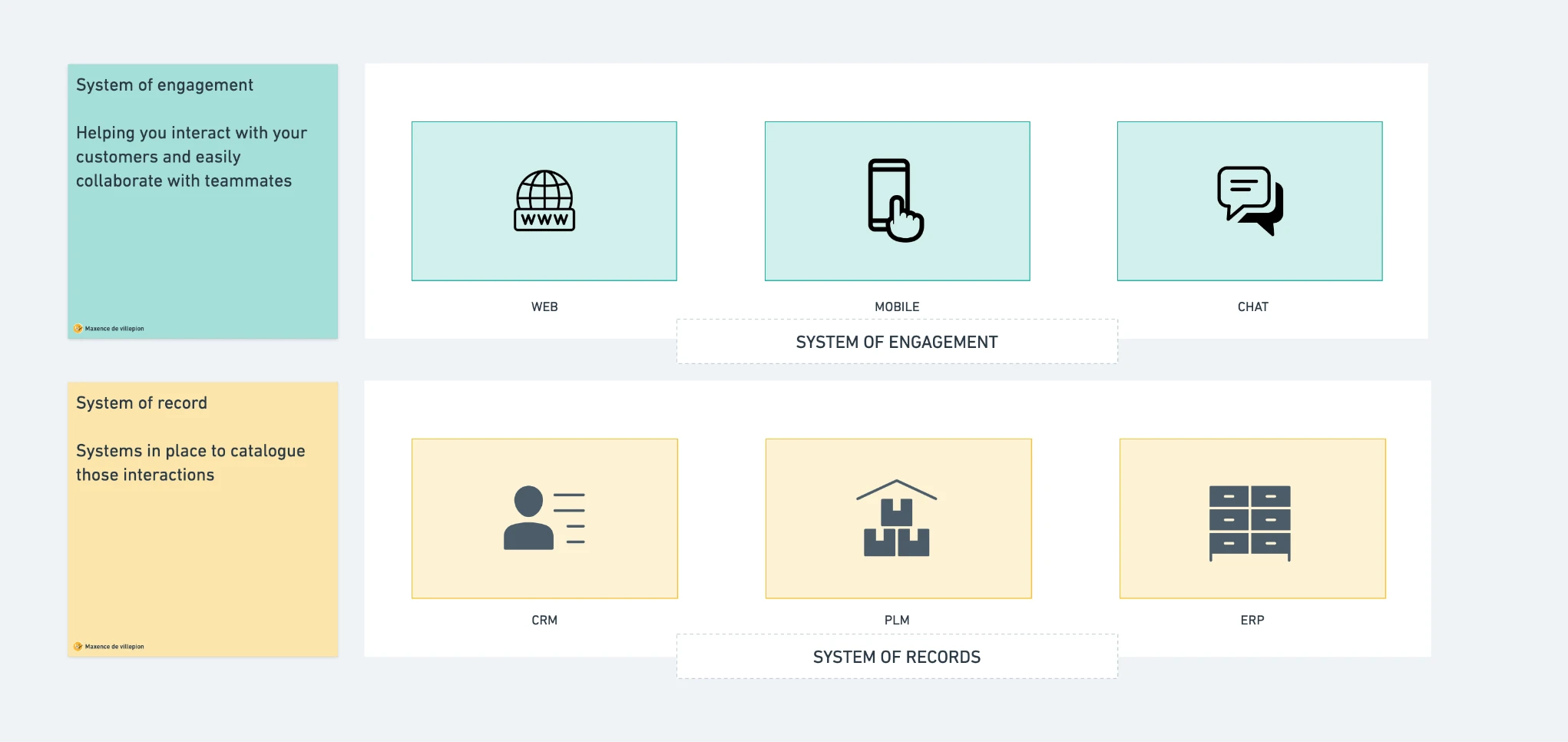
A CRM, for instance, is both a system of record for customer data (each record contains company or contact information) and a system of engagement that provides a user-friendly interface to collaborate and engage with customers.
Traditionally, the main advantage of grouping these two systems is creating a seamless link between customer engagement and back-end processes.
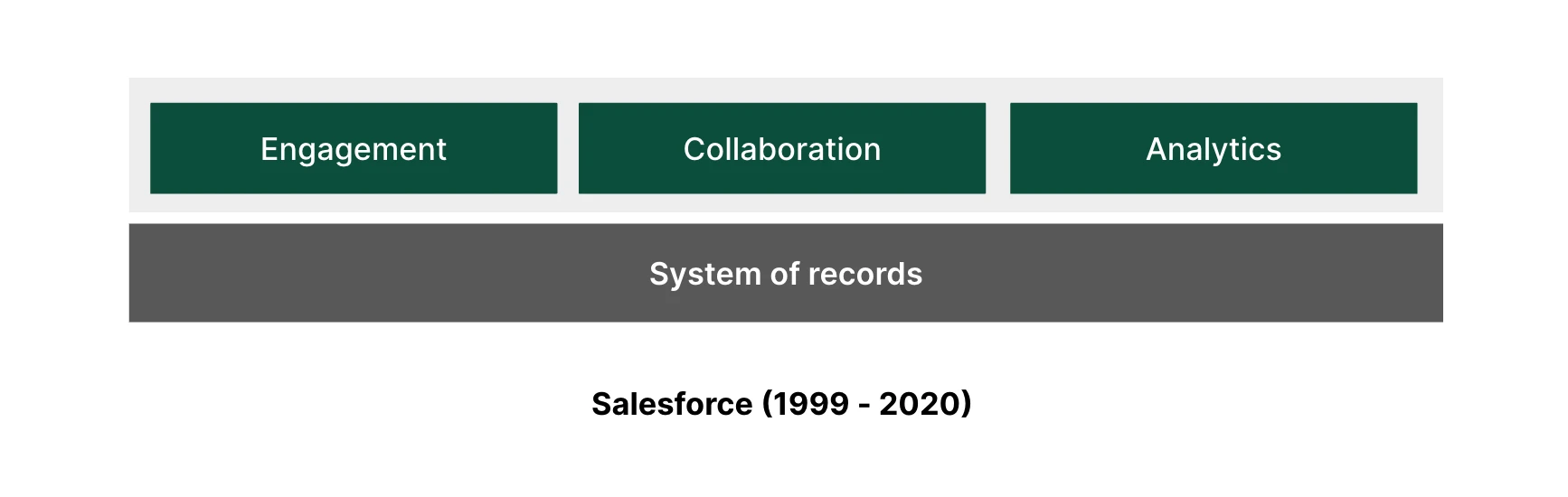
The Unbundling Era: Why CRMs Can’t Be Everything Anymore #
With the sophistication of go-to-market strategies, things are different now. We live in an unbundled era where you will have idiosyncratic tools for each use case. According to BetterCloud, an average SaaS company uses 80 different SaaS apps.
For instance, let’s take a typical stack for SaaS:
You have Salesforce used as the system of record for sales; the interface and collaboration layer is a tool like Dooly that sits on top of Salesforce to provide better UI. You’d have Salesloft or Outreach for sales outreach and Braze or Hubspot for customer engagement. When it comes to reporting or analytics, you’d do it on Looker or Metabase.
Yes, Salesforce is still used today as the system of record for sales data, but it can no longer be considered the single source of trust for your business.
The Data Fragmentation Problem
The reason is that a company uses too many systems of record, and each department has its favorite ones, causing internal misalignment and conflicts:
- Sales: Salesforce for pipeline data
- Marketing: HubSpot for campaigns and leads
- Product: Mixpanel or Amplitude for usage analytics
- Support: Zendesk for tickets
- Finance: Stripe or Chargebee for billing
Today’s SaaS locked-up architecture does not help companies embrace the ever-growing sources and complexity of data.
The Rise of Cloud Data Warehouses as Single Source of Truth
To make sense of all those data, modern companies turn to Cloud Data Warehouses like Snowflake to unify and reconcile their data from different tools.
CDWs are becoming the single source of trust to align teams internally.
This shift from CRM-as-hub to warehouse-as-hub is fundamental. When your data lives in 10+ different systems with different schemas, you need a centralized layer that:
- Unifies: Brings all data into one place
- Transforms: Reconciles different schemas into consistent business entities
- Governs: Provides enterprise-grade security, observability, and control
- Aligns: Creates a single definition of customer, account, pipeline, ICP, etc.
✔️ According to Sirius Decision, B2B businesses that align their revenue engine grow 12X to 15X times faster than their peers and are 34% more profitable.
What This Means for the Future #
The traditional model of CRM as both system of record AND engagement is broken. The future is:
- Warehouse as System of Record: Single source of truth (covered in Part 2: Warehouse-First Architecture)
- Specialized engagement layers: Tools built to query warehouse directly, not store duplicate data
- AI-powered operations: Autonomous agents that consume warehouse data
Key Takeaways #
- SOE vs SOR difference: Systems of Record store data (CRM databases, warehouses, ERP). Systems of Engagement provide interfaces for human interaction (CRM UI, sales engagement tools, marketing automation). Traditional CRMs bundled both, this worked when CRM was the only GTM tool, but broke with 80+ SaaS apps.
- CRMs can’t be single source of truth anymore: Data proliferation across departments (Sales = Salesforce, Marketing = HubSpot, Product = Mixpanel, Support = Zendesk, Finance = Stripe). Each uses different schemas. Syncing via APIs creates delays, conflicts, cost explosion, fragility. Result: No one trusts CRM, internal battles over “whose data is right.”
- Cloud Data Warehouses are the new hub: Companies turn to CDWs (Snowflake, BigQuery) to unify all GTM data. Warehouses provide single source of truth, enterprise security, custom business entities. Companies that align revenue engine around unified data grow 12-15x faster (Sirius Decision).
Frequently Asked Questions #
System of Record (SOR): Stores and manages data. Focus: Data integrity, historical record, persistence. Examples: CRM databases (Salesforce), data warehouses (Snowflake), ERP systems. Purpose: “What data do we have?”
System of Engagement (SOE): Interfaces for human interaction with customers/teams. Focus: Communication, collaboration, user experience. Examples: CRM UI (Salesforce interface), sales engagement (Outreach), marketing automation (Braze), collaboration (Slack). Purpose: “How do we use data to interact?”
Traditional CRMs bundled both: Salesforce = records (customer/contact data storage) + engagement (UI to manage pipelines, send emails, track activities). This worked when CRM was the only GTM tool. Now with 80+ SaaS apps, the bundle broke, specialized engagement tools (Outreach for sequences, Dooly for better UI) sit on top of separate records systems.
Data proliferation across departments: Each function adopted specialized SORs, Sales (Salesforce), Marketing (HubSpot), Product (Mixpanel/Amplitude), Support (Zendesk), Finance (Stripe/Chargebee). Customer data, sales data, product usage, support tickets all live in different systems with different schemas.
Locked-up SaaS architectures: Each tool uses proprietary data models. Salesforce’s Lead/Contact/Account objects don’t match HubSpot’s structure or your actual business entities (What’s a Workspace? Team? Donation?). You’re forced to fit business to tool’s schema, not tool to business.
Sync hell: Keeping these systems aligned via APIs creates: data delays (batch syncs every hour/day), conflicts (which is authoritative?), cost explosion (sync 6M records daily = expensive API calls + duplicate storage), fragility (one broken integration breaks downstream processes).
Result: No one believes CRM is source of truth. Sales trusts Salesforce, Marketing trusts HubSpot, Product trusts Mixpanel, internal battles over “whose data is right.”
Classic SOEs: CRM interfaces (Salesforce Lightning, HubSpot UI), Sales engagement platforms (Outreach, Salesloft, Apollo), Marketing automation (Braze, Marketo, Iterable), Customer support (Zendesk, Intercom), Collaboration tools (Slack, Teams)
Modern SOEs: Warehouse-native apps (Cargo, queries data warehouse directly), AI agent platforms (autonomous research, scoring, routing), Real-time engagement engines (event-driven personalization)
Key trait: All focus on enabling humans to interact with customers/data through intuitive interfaces, workflows, and automation, rather than just storing data.
Continue the Series #
Part 2: Warehouse-First Architecture
Learn why the future of engagement layers query warehouses directly instead of syncing data. Eliminate duplicate data costs and create a true single source of truth.
Complete Guide
Read all three parts in one comprehensive resource. The complete journey from CRM-centric to AI-powered revenue operations.
AurelienDec 14, 2025