Every definition of revenue orchestration currently in circulation traces back to the same sentence. Forrester wrote it, and most vendors repeat it close to verbatim: technology that enables B2B frontline resources to design, execute, capture, analyse and improve buyer and customer engagement while optimising productivity and internal revenue processes.
It is a reasonable description of a market. Sales engagement, conversation intelligence and revenue operations tooling really are converging, and buyers really do want fewer vendors.
But it is a description of what you buy, not of how the system works. And it carries an assumption that is quietly expiring: that humans supply the commercial judgment and software carries out their instructions.
That assumption held for as long as software could not evaluate an account. It no longer holds. An agent can now read a funding announcement, check it against your customer base, decide the account is worth pursuing, identify who to contact and draft the message. The moment software participates in the judgment rather than only the execution, a different question becomes the important one:
Where should commercial decision logic live?
That question is what revenue orchestration is actually about.
What is revenue orchestration #
Revenue orchestration is the decision and coordination layer of go-to-market infrastructure. It sits between customer context and activation systems, determining which accounts matter, what should happen next, who owns the account and how execution is coordinated across the revenue stack. In a modern implementation, that logic is explicit rather than implicit: written down, versioned, and readable by both the people and the software acting on it.
Two things follow from that definition.
The first is that revenue orchestration is not the whole go-to-market stack. It is one layer inside it, with a specific job.
The second is that the valuable part is not the connections. Connecting systems is a solved problem and has been for a decade. The valuable part is the logic that runs between knowing something and doing something about it.
How revenue orchestration evolved #
Three stages, and most companies are somewhere in the second.
1. Move data
The first generation kept systems synchronised. Enrich the CRM, propagate an update, push product usage into Salesforce, reconcile two records that describe the same company.
The operating question was: how do we get the right data into the right system?
This work is necessary and it is still not finished at most companies. But it produces no decisions. A perfectly synchronised CRM tells you what is true. It does not tell you what to do.
2. Run workflows
The second generation coordinated predefined actions across systems. Route a lead, trigger enrichment, post a Slack alert, enrol a contact into a sequence, reassign ownership.
The operating question was: when X happens, what should execute?
This is where most revenue teams operate now, and it is where most tools stop. It works well when the rules are simple and the volume is manageable. It degrades badly when there are two hundred rules, four systems that each hold part of the logic, and nobody who can say with confidence why a particular account was routed the way it was.
The limitation is structural rather than technical. A workflow executes a decision that a human already made when they built it. It does not make one.
3. Coordinate commercial decisions
The emerging problem is harder, and it is a question rather than a trigger:
Given everything we know about this account, our commercial strategy and our current constraints, what should the business do next?
That decomposes into questions a workflow cannot answer on its own. Is this account worth pursuing at all. Is now the moment, or is this noise. Which motion applies, direct or partner or self-serve. Which people matter inside the account. Who should own it, given who already owns what. Should something currently running be stopped. If two plays both want this account, which one wins. And can software act here on its own, or does this one need a person.
Those are commercial decisions, not routing rules. They depend on strategy, on capacity, on what you have learned about which customers succeed. They are the part of go-to-market that has historically lived in a founder’s head, a RevOps lead’s spreadsheet and a quarterly planning document.
Revenue orchestration is the layer where that logic stops being implicit.
Where orchestration sits #
Go-to-market infrastructure has four layers, and orchestration is the third.
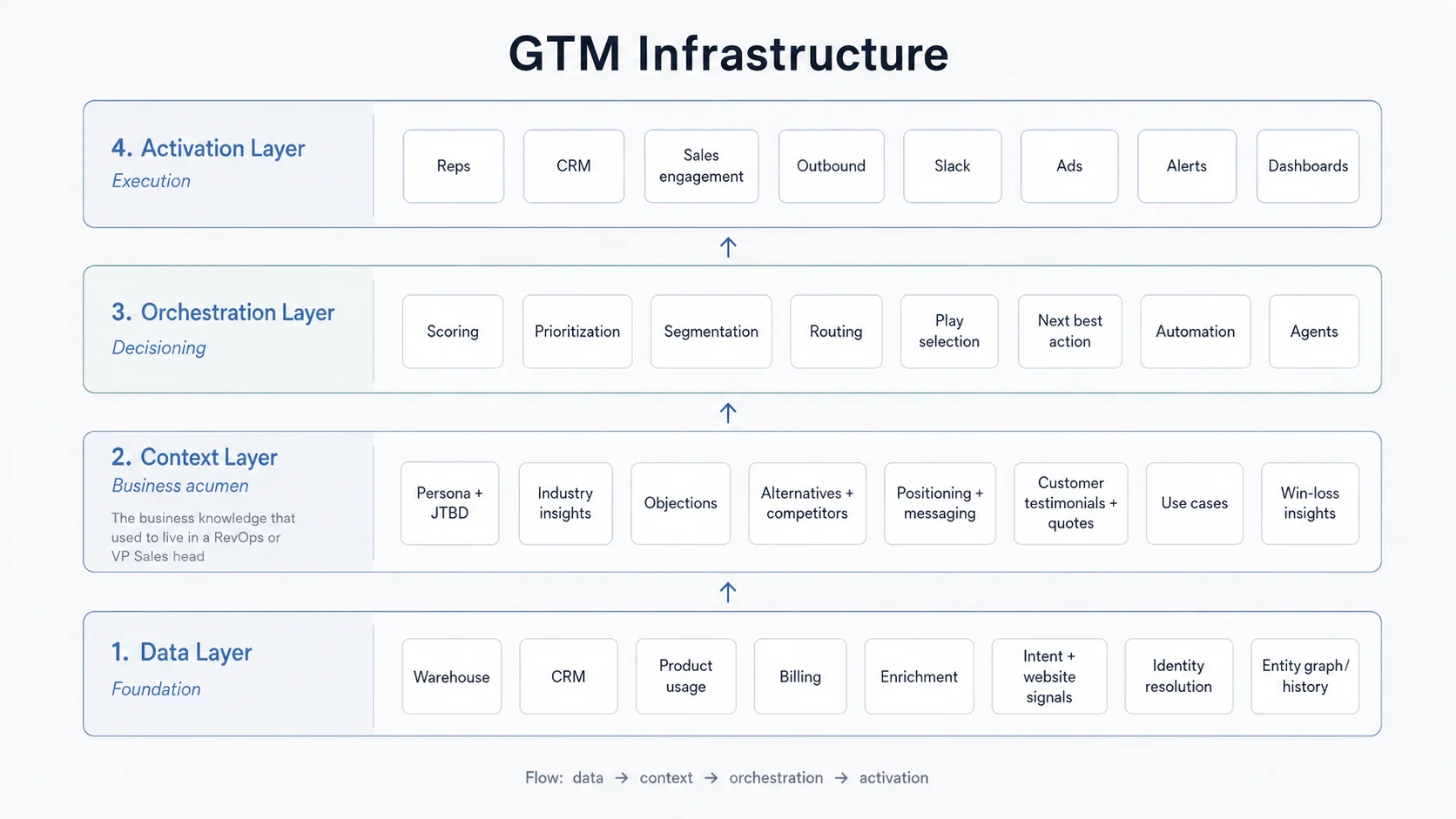
Data. What is happening and what is true. CRM records, warehouse tables, product usage, billing, enrichment, intent, website activity, and the work of resolving several records into the one company they actually describe.
Context. What the business knows. Personas and the jobs they are trying to do. The pains, and the objections that follow from them. Positioning. Competitors, and the alternatives buyers genuinely consider, which are rarely the same list. Industry-specific insight. Use cases. Customer stories, and the quotes that carry them. Qualification logic. Sales methodology. Product knowledge. And the patterns learned from deals won and lost.
This is the layer almost no company has written down. It lives in a founder’s head, in the best rep’s instincts, and in a positioning deck nobody has opened since the workshop that produced it.
Orchestration. What the business should do about it. Scoring, prioritisation, segmentation, routing, ownership, play selection, next best action, and the decision about whether software or a person should act.
Activation. Where the decision reaches a human being: reps, the CRM, sales engagement platforms, outbound, Slack, advertising, alerts, dashboards, and increasingly custom interfaces built around the specific decision a team makes over and over.
Stated as a sequence:
Data is what happened. Context is what the business knows. Orchestration decides what to do about it. Activation carries it out.
The difference between the first two layers is the one people collapse. Data tells you a company raised a Series B. Context tells you whether that matters, for whom, and what to say about it.
Most go-to-market stacks are strong at the first layer and extremely well served at the fourth. Vendors have competed on data and on activation for twenty years. The two in the middle are where almost nothing is built: context lives in people’s heads, and orchestration happens in meetings.
Why AI agents change the orchestration layer #
For as long as the intelligence lived in people, a thin orchestration layer was survivable. A rep looked at an account and decided. Automation moved things around them.
Agents change the shape of the problem, because an agent can now interpret a signal, research a company, evaluate fit, identify stakeholders, recommend an action and carry it out. Software has entered the judgment layer. The jobs agents hold in production, and the gates they run under, are mapped in AI agents for GTM.
That creates an architectural question that did not previously need answering. If three agents are operating on your market, where does your positioning live? Which objections have approved answers, and what are they? What separates a good-fit account from one that looks identical on paper and churns in four months? Which competitor claims are worth rebutting? Which customer story lands with a security buyer rather than a growth lead?
None of those are data questions. No enrichment provider sells them. They are the institutional knowledge that makes a decision correct rather than merely fast, and for most companies it has never been written down anywhere.
There are only two places it can go, and one of them is bad.
Either each agent carries its own copy, in which case you have as many versions of your go-to-market strategy as you have agents, none of them quite matching, and no way to change all of them at once. Or the context and the policy live outside the agents, in shared infrastructure they all read from, and an agent becomes something that executes your strategy rather than something that improvises one.
This is why the orchestration layer becomes more important rather than less as agents get better. The more capable the actors, the more it matters that they are operating from the same governed logic.
Making the logic explicit #
There is a practical consequence to all of this, and it is where the phrase GTM as Code becomes useful rather than decorative.
If commercial decision logic is going to be shared by people and software, it has to exist in a form both can read. That means revenue logic stops living in people’s heads and in the configuration screens of six different tools, and becomes explicit: written down, auditable, reusable and testable.
Once it is explicit, a set of things become possible that were not possible before. A human can read the rule that decided something. An agent can reason over the same rule instead of approximating it. A change can be reviewed before it ships. A policy can be versioned, so you can say what the rule was in June. A scenario can be tested against last quarter’s data. An execution can be observed. A failure can be replayed.
None of that is available when the logic is distributed across workflow builders and the working memory of three people.
What revenue orchestration looks like in practice #
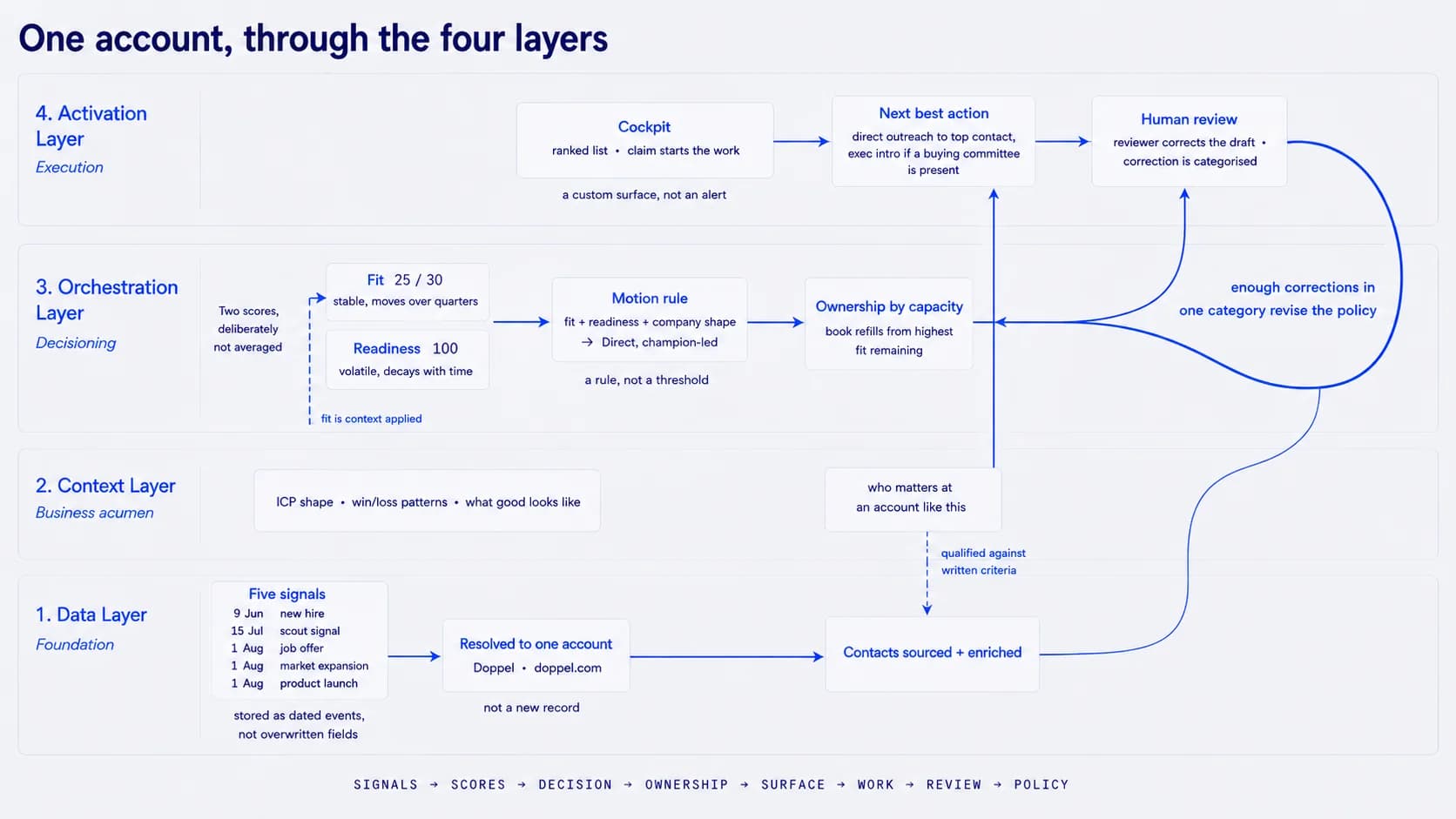
Here is one account moving through the system, in our own go-to-market.
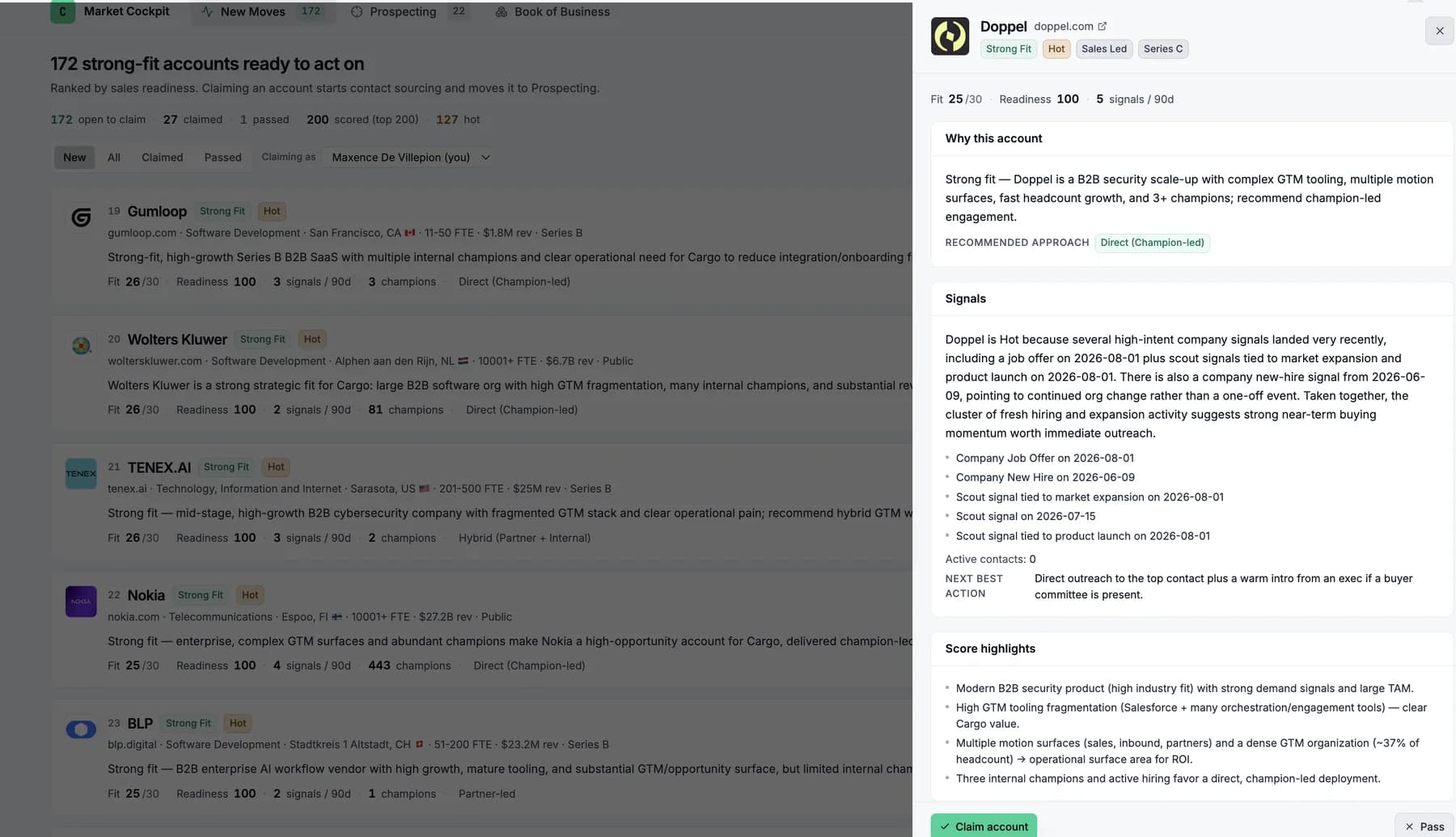
Doppel is a Series C B2B security company, between two and five hundred people and hiring, running a sales-led motion on Salesforce plus a long tail of orchestration and engagement tools. Nobody at Cargo had been speaking to them.
Something changed, five times. Between the ninth of June and the first of August, five separate company-level signals arrived: a new hire, a job posting, and three signals tied to market expansion and a product launch. Each was stored as an event with its source and the date it occurred, not written over a field. That matters more than it sounds. A field tells you the current state. A sequence of dated events tells you that something is happening now, and lets you answer three weeks later why this account became interesting. Three of the five landed on the same day.
The signals landed on the account we already had rather than creating another record for a company we already knew about. That is data work, and it is the step most stacks fail at quietly.
Two separate scores were calculated, and they measure different things. Fit asks whether this company belongs in our market at all, and answering it draws on context rather than data: not Doppel’s headcount, but what we have learned about which companies succeed with us and which look similar and do not. Doppel scored 25 out of 30, on a shape we recognise, a modern B2B software company with fragmented go-to-market tooling, more than one motion running at once, fast headcount growth, and at least three plausible internal champions. Readiness asks whether something is happening right now, and weights recent signals more heavily than old ones. Doppel scored 100.
Most systems collapse these into one number. That is a mistake, because they behave differently. Fit is stable and changes over quarters. Readiness is volatile and decays: a funding round from last week means something, the same round eighteen months ago means very little. Averaging a stable score with a volatile one produces a number that is wrong in both directions.
The combination triggered a decision, and the decision named a motion. Not a score above a threshold, but a rule: given this fit, this readiness and this company shape, the account enters direct outreach, champion led. A different combination produces a different answer. Low fit and high readiness is not an opportunity, it is a distraction. High fit and low readiness is a nurture, not a call.
Ownership was assigned by capacity, not by whoever noticed first. Each rep holds a fixed book of accounts. When an account is disqualified, the pool refills from the highest-fit accounts remaining, automatically. That single rule removes a category of work that usually consumes a Monday morning: deciding who gets what.
The decision surfaced where the work happens. Not an alert, and not a row in a report: a ranked list of accounts inside an interface built for one job, claiming an account and starting on it. That is the activation layer, and for the decisions a team makes every day it is increasingly a custom surface rather than someone else’s inbox.
Claiming the account started the work. Contact sourcing ran, found the people at the company, qualified them against a written definition of who matters at an account like this one, and enriched only the ones that survived. The system’s recommendation was specific: direct outreach to the top contact, with a warm introduction from an executive if a buying committee is present.
Note what the system said about the state of the relationship: fresh hiring and expansion activity, and zero active contacts. It is not claiming Doppel is in a buying process. It is claiming the conditions are right and nobody has acted on them yet, which is a different and more honest statement.
A person reviewed the message before it went out, and their edit changed the rule. This is the part that matters most. When a reviewer corrects a draft, the correction is categorised rather than just applied. Enough corrections in the same category, and the policy that produced them is revised. The human is not a quality gate at the end of a pipeline. They are the mechanism by which the logic improves.
That is the whole difference between a human in the loop and a human in the system. In the first, a person approves what software produced. In the second, what the person knows becomes part of what the software knows next time.
Revenue orchestration and adjacent categories #
| What it does | How orchestration differs | |
|---|---|---|
| Workflow automation | Executes predefined sequences when a trigger fires | Applies commercial logic across systems and decides which action should happen at all |
| Sales engagement | Executes interactions with prospects and customers | Decides whether, when, why, through whom and through which motion those interactions occur |
| CRM | Records customer and commercial information | Operates across systems and applies logic that cannot sensibly live inside a single record |
| GTM infrastructure | The whole stack: data, context, orchestration, activation | Is one layer of it, not a synonym for it |
Where this goes #
Once the same system connects context, decisions, actions and the outcomes those actions produce, something becomes possible that is not possible when those four things live in different places. The system can observe whether its own decisions were any good, and adjust.
That is the direction: a closed loop where the engine senses what changed, decides what to do, coordinates the doing, observes the result and improves the policy that produced it. Human judgment stays in the loop where judgment is what is needed.
No company has finished building this, and any vendor claiming otherwise is describing a roadmap. But the architecture is not speculative. Making commercial decision logic explicit, governed and observable is a prerequisite for it, and that part is buildable today.
How Cargo thinks about it #
Cargo is agentic go-to-market infrastructure, built around this architecture. In practice that means three things.
It brings together the data and context a commercial decision requires, from first-party systems and external sources, resolved to one account rather than five records.
It lets teams encode and run the commercial logic itself: scoring, prioritisation, routing, ownership, next best action, and the rules governing when software may act alone.
And it coordinates the resulting actions across the systems and agents that execute them, with the decisions observable after the fact.
The Doppel example above is our own go-to-market, running on it.
Frequently asked questions #
What is revenue orchestration? Revenue orchestration is the decision and coordination layer of go-to-market infrastructure. It sits between customer context and activation systems, determining which accounts matter, what action should happen, who owns it and how execution is coordinated across the revenue stack.
What does a revenue orchestration platform do? It brings together the data and context needed to make a commercial decision, applies the logic that determines what should happen, and coordinates execution across the systems that reach customers. The distinguishing capability is the decision, not the connection.
How is revenue orchestration different from workflow automation? Workflow automation executes a decision a human already made when they built the workflow. Revenue orchestration makes the decision, using shared context and explicit commercial policy, then coordinates the execution that follows.
How do AI agents change revenue orchestration? Agents can now interpret signals, evaluate accounts, choose stakeholders and act. That moves software into the judgment layer and raises a question that did not previously need answering: where commercial policy lives. If each agent carries its own copy, a company has as many go-to-market strategies as it has agents. Shared, governed decision logic is what stops that happening.
 MaxAug 11, 2026