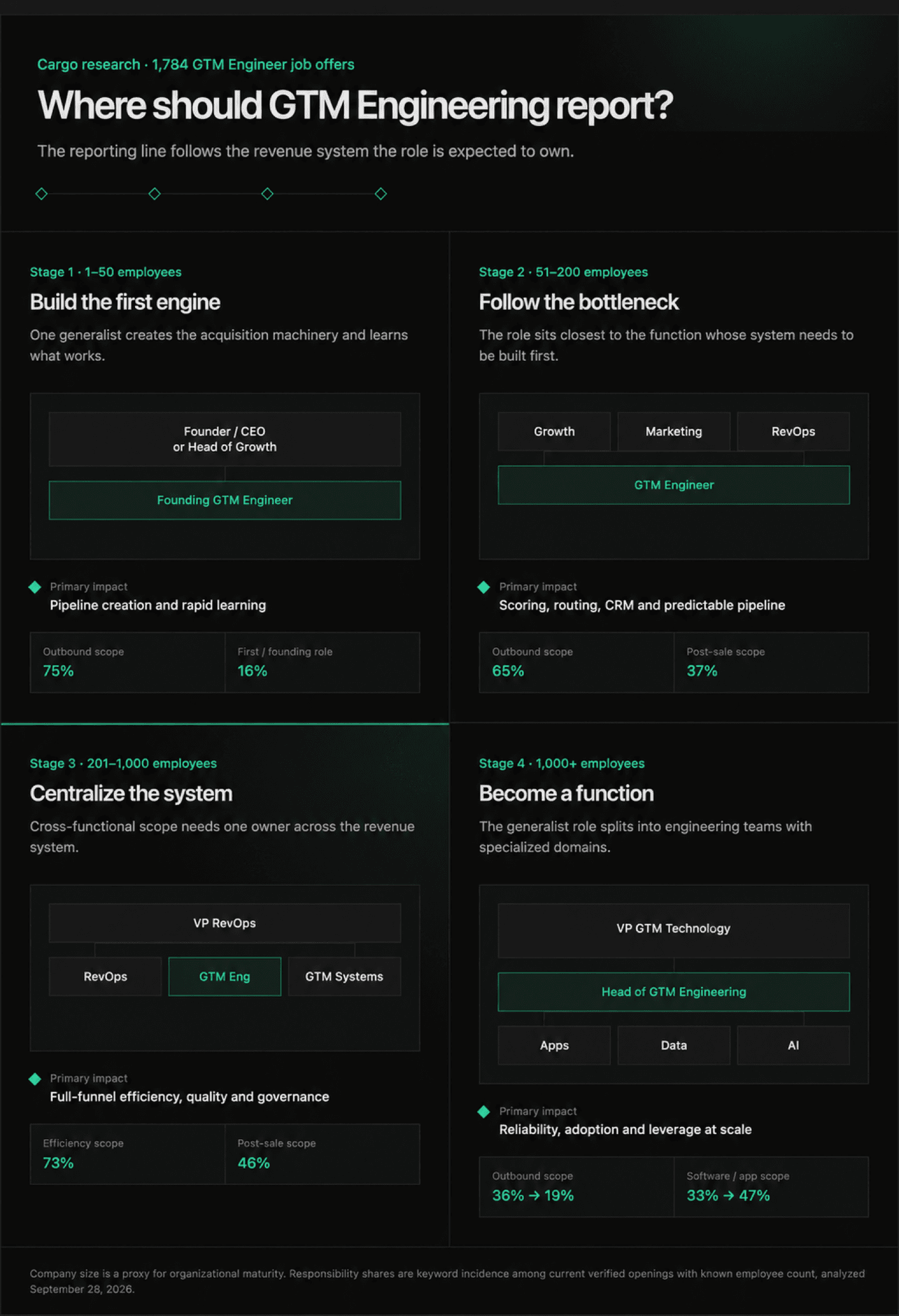
GTM Engineering should report to the leader who owns the revenue system it is expected to change. In an early startup, that is usually the founder. In a scale-up, it is usually RevOps, Revenue Systems, or Growth. Once the role spans Sales, Marketing, and Customer Success, the best home is RevOps or GTM Systems. At enterprise scale, GTM Engineering should become its own function under a Head or Director of GTM Engineering, or a VP of GTM Technology.
The wrong shortcut is to put the team under whichever department submits the most requests. Reporting into Sales does not make sense merely because sales reps consume the output. Reporting into Marketing does not make sense merely because the first use case is outbound. The reporting line should follow the system boundary, not the loudest stakeholder.
A GTM Engineer owns the revenue system: the data, enrichment, scoring, routing, automation, and AI workflows that decide who the company engages, when, and how.
Our default answer: before 50 employees, report to the founder or executive sponsoring the motion. From roughly 50 to 200, report to the functional leader who owns the immediate bottleneck. From 200 employees onward, centralize the role under RevOps, Revenue Systems, or GTM Systems. Create a dedicated GTM Engineering management layer once the work becomes a multi-engineer function.
The reporting structure changes with company size and maturity #
There is no universally correct manager because the job itself does not stay constant. It starts as a founder’s leverage role, becomes a functional systems builder, then turns into a cross-functional engineering team.
| Company stage | Recommended reporting line | What GTM Engineering is there to do |
|---|---|---|
| 1–50 employees | Founder, CEO, COO, or Head of Growth | Build the first repeatable acquisition and revenue engine |
| 51–200 employees | Growth, Marketing, or RevOps, based on the bottleneck | Turn an emerging motion into reliable scoring, routing, CRM, and pipeline systems |
| 201–1,000 employees | VP of RevOps, Head of Revenue Systems, or Head of GTM Systems | Own shared systems across Sales, Marketing, and Customer Success |
| 1,000+ employees | Head or Director of GTM Engineering, or VP GTM Technology | Run a durable engineering function with application, data, automation, and AI specialties |
1–50 employees: report to the person designing the motion
At this stage, the GTM Engineer is often the revenue systems function. Sixteen percent of job descriptions in this bucket describe the hire as the first or founding GTM Engineer. Outbound and prospecting appear in 75% of the roles, while CRM and revenue systems appear in 77%.
The right manager is normally the founder, CEO, COO, or Head of Growth because that person can make decisions across the whole company. The role needs access to the strategy and permission to change the motion quickly, not a queue of requirements handed down by one department.
This is also why reporting to a first-line sales manager is usually too narrow. A founding GTM Engineer may need to change the ICP, data model, qualification policy, website forms, territories, and customer expansion signals in the same month. A manager responsible only for rep output cannot arbitrate all of those tradeoffs.
51–200 employees: report to the owner of the bottleneck
This is the least standardized stage because companies are solving different constraints. Marketing or Growth is the most common home when demand creation is the bottleneck; RevOps or Revenue Systems becomes the stronger choice when the problem is process, data, or control.
That fragmentation is rational. Companies at this size are hiring against different bottlenecks:
- If the constraint is demand creation, signal capture, or outbound experimentation, the role can sit in Growth or Marketing.
- If the constraint is CRM integrity, lead management, attribution, territory logic, or forecastability, it should sit in RevOps.
- If the role is the first technical builder serving every GTM function, it can still report to the founder or COO.
The placement should be reviewed once the first bottleneck is solved. A GTM Engineer hired by Marketing to build acquisition systems should not remain trapped inside Marketing when the systems now route leads, trigger sales actions, and surface expansion opportunities for Customer Success.
201–1,000 employees: centralize GTM systems ownership
At this stage, centralizing GTM Engineering under RevOps, Revenue Systems, or GTM Systems is the clear default. Eighty percent of stated reporting lines follow that model. The work has also become meaningfully more cross-functional: 34% of descriptions span Sales, Marketing, and Customer Success, versus 10% in companies with 50 employees or fewer.
The outcome changes too. Efficiency or productivity appears in 73% of these job descriptions, data quality in 51%, and post-sale or expansion work in 46%. The role is no longer only building an outbound engine. It is building infrastructure used across the customer lifecycle.
At this stage, RevOps, GTM Engineering, and GTM Systems need one accountable leader. That is usually a VP of RevOps when the work is primarily process and systems, or a GTM Technology leader when the team owns production software and data infrastructure:
- RevOps owns process, governance, planning, and operating cadence.
- GTM Systems owns critical applications and administration.
- GTM Engineering builds new cross-system capabilities and reusable infrastructure.
The functions work together, but they do not collapse into one job. Governance without builders becomes a ticket queue. Building without governance creates a fast-moving collection of systems nobody trusts.
1,000+ employees: make GTM Engineering a function
Large-company job descriptions show a different role shape. Outbound scope drops from 75% at companies with 50 employees or fewer to 36% at companies with 1,001–5,000 employees and 19% above 5,000. At the same time, software and application engineering scope rises from 9% to 33%, then 47%.
This is the transition from GTM Engineer as a generalist to GTM Engineering as an organization. The team may include application engineers, data engineers, AI engineers, and platform specialists. Individual contributors should report to a Head or Director of GTM Engineering, who reports to a VP of GTM Technology or sometimes RevOps.
The primary requirement is a durable engineering charter. If the team owns production applications, shared data services, and AI systems, it needs engineering practices and a leader who can fund reliability, security, and maintenance—not only the next campaign.
What current job offers reveal about the manager #
The market’s center of gravity is GTM Engineering and RevOps. Together, they account for 54% of stated reporting lines.
| Reporting line | Share |
|---|---|
| GTM Engineering / GTM Systems | 30% |
| RevOps / Revenue Systems | 23% |
| Marketing / Growth | 20% |
| Founder / CEO / COO | 13% |
| Operations / Strategy / Internal Tools | 9% |
| Sales / CRO | 4% |
Company maturity explains the variation. Founder reporting is concentrated in small companies. Marketing and Growth are most common while the company is establishing its motion. RevOps and GTM Systems dominate once the role owns infrastructure across the revenue lifecycle.
The responsibilities move in the same direction: less campaign execution, more system ownership; less outbound concentration, more application engineering; and more emphasis on efficiency, data quality, and the full customer lifecycle.
Should GTM Engineering report to RevOps? #
Usually, yes—once the company needs one shared revenue system. RevOps is the best default home when it owns end-to-end process design, has credibility across functions, and can give engineers authority to change the underlying systems.
RevOps is the wrong home when it operates only as CRM administration or a reactive service desk. A GTM Engineering team measured by ticket throughput will optimize for request completion instead of compounding infrastructure. The role needs a roadmap, production ownership, and room to reject one-off requests that make the overall system worse.
A useful test is simple: can the RevOps leader say no to Sales, Marketing, and Customer Success in order to protect a shared revenue architecture? If yes, RevOps is the right home. If not, GTM Engineering needs a broader executive sponsor, such as the COO or a GTM Technology leader.
Should GTM Engineering report to the CRO? #
It can, but the title alone is not a reason. A CRO is the right executive sponsor when they genuinely own the full revenue lifecycle and treat GTM Engineering as infrastructure. That means funding work whose payoff is data quality, reliability, reuse, or future efficiency—not only this quarter’s pipeline.
The CRO is the wrong manager when the role will be absorbed into short-term sales execution. GTM Engineering serves Sales, but it also changes Marketing, Customer Success, finance data, product signals, and the warehouse. If every priority is judged through the sales forecast, the system boundary will shrink to whatever helps reps this quarter.
Our rule: report GTM Engineering to the CRO only if its cross-functional systems charter remains intact. Do not move the team merely because a CRO was hired.
Should GTM Engineering report to Marketing or Growth? #
Yes, when acquisition is the dominant constraint and the role’s charter is explicitly growth-oriented. This is most common while a company is turning an emerging motion into a repeatable growth system.
The arrangement works when the GTM Engineer is building signal capture, enrichment, audience generation, inbound qualification, experimentation, and outbound infrastructure. It stops working when the role becomes responsible for shared CRM policy, territories, post-sale automation, and data used by every revenue function.
Marketing can incubate GTM Engineering. It should not automatically own the function forever.
How to choose the reporting line #
Use four decisions, in this order.
1. Draw the system boundary
List what the team will own in the next 12 months: CRM, warehouse models, enrichment, scoring, routing, outbound, product signals, expansion plays, internal apps, and AI agents. The manager must have authority across that boundary.
2. Name the current constraint
Is the company missing demand, or is it losing demand inside unreliable systems? Acquisition constraints point toward Growth. Process and data constraints point toward RevOps. Cross-functional engineering constraints point toward GTM Systems or dedicated GTM Engineering leadership.
3. Separate the manager from the customers
Sales, Marketing, and Customer Success should be customers and roadmap partners even when none of them manages the team. The manager resolves tradeoffs; stakeholders provide requirements, adoption, and feedback.
4. Match metrics to the charter
An acquisition-oriented team may own qualified pipeline coverage and conversion. A shared-systems team should also own system adoption, automation coverage, data correctness, latency, reliability, and cost per workflow. If the manager cannot support those metrics, the organizational home is too narrow.
Common reporting-line mistakes #
Putting the team under the biggest requester
Request volume is not system ownership. It turns a platform team into dedicated implementation capacity for one function.
Treating GTM Engineering as technical RevOps labor
RevOps and GTM Engineering should share an operating model, but the engineer needs ownership of architecture and reusable systems—not only tickets that require code.
Moving the team every time the bottleneck moves
The placement may change once during the transition from function-specific builder to shared platform. Reorganizing it every quarter destroys ownership. Change the roadmap more often than the reporting line.
Creating a central team with no embedded relationships
Neutral does not mean distant. A centralized GTM Engineering function still needs named partners in Sales, Marketing, Customer Success, data, and security, plus shared planning and adoption metrics.
The principle to keep #
The question is not, “Who uses the GTM Engineer most?” It is, “Who owns the revenue system this person is building?”
As the company grows, that answer moves from a person, to a function, to an engineering organization:
- Founder when the motion is still being invented.
- Growth or RevOps when one functional bottleneck dominates.
- RevOps or GTM Systems when the system crosses the funnel.
- Dedicated GTM Engineering leadership when the systems become an engineering organization.
The reporting line is correct when the manager has the same system boundary, time horizon, and outcome as the team.
FAQ #
A GTM Engineer should report to the leader who owns the revenue system they are expected to change. That is usually a founder in an early startup, Growth or RevOps in a scale-up, RevOps or GTM Systems once the work spans the funnel, and dedicated GTM Engineering or GTM Technology leadership at enterprise scale.
Usually yes when RevOps owns end-to-end revenue process and can give the team a systems roadmap. No when RevOps is primarily CRM administration or a ticket queue. In that case, GTM Engineering needs its own leader or a broader executive sponsor.
Only when the CRO owns the full customer lifecycle and protects the team’s cross-functional, long-term systems charter. Hiring a CRO is not by itself a reason to move the team under Sales leadership.
Create the function when multiple engineers own production revenue systems, shared data services, internal applications, or AI infrastructure. At that point, the work needs engineering management, reliability standards, and a durable platform roadmap.
The role moves from a founder-led generalist at 1–50 employees, to a function-specific builder at 51–200, to a centralized systems capability at 201–1,000, and finally to a specialized engineering organization at enterprise scale.
This answer is based on Cargo’s dataset of 1,784 GTM Engineer job offers posted from April 17 to September 28, 2026, including 1,181 positions verified open on our live GTM Engineer job board. For the company-size analysis, we matched 1,120 current postings to full job descriptions, deduplicated them to 1,022 roles, and identified employee count for 756 companies. Only 69 descriptions explicitly named a manager, so we use those reporting lines as directional evidence and test them against how the responsibilities change across the much larger sample. Responsibility percentages measure whether a topic appears in a description, not the percentage of time spent on it. Company size is a proxy for organizational maturity.
 MaxSept 28, 2026