Every GTM platform now tells you it works with AI agents, and most of them are telling the truth. An MCP endpoint takes weeks to ship. An API was already there. Access is table stakes, and any comparison page pretending otherwise is selling something.
So the question moved. It is no longer whether an agent can call your GTM stack. It is what happens after the call connects: can the agent read the state of the system, change it safely, see what its change did, and fix what it broke?
An agent operates well where its environment is legible, safe, and self-correcting, in the agent’s native medium. That is the whole test. An agent-ready GTM platform is one an AI agent can operate end to end: read and write governed state through typed interfaces, change the system through reviewable code rather than clicks, observe every run it triggered, and repair what it finds broken. An API or an MCP endpoint establishes access. It establishes none of the rest.
What follows is not a feature list. It is the argument chain, eight links an engineer can check with the documentation open. Break any one and you have a demo, not an operator. If you want the wider picture of the work itself first, start with what AI agents actually do in GTM today, or with the layer underneath them, GTM infrastructure.
1. The whole system is code, which is the agent’s native medium #
Open any GTM tool of the last decade and you are looking at a UI designed for a human with a mouse. The agent gets a browser session to puppeteer or a partial API bolted on after the fact.
Cargo inverts this. The entire workspace is defined in TypeScript: models, tools, agents, plays (Cargo’s deployed workflows), connectors, apps. A plan shows the diff before anything lands, a deploy reconciles it, staging and production are separate targets, and a new engine scaffolds from cookbooks instead of a blank canvas.
So an agent does not “use” Cargo through screens it was never designed for. It reads your GTM system the way it reads a repo: diffs it, reasons about it, proposes changes as reviewable code. The primary interface and the agent’s native medium are the same thing.
That one property does more work than any feature on this page. It is why a commercial operator with no engineering background, paired with Claude Code, went from first demo to the tenth version of a working enrichment play in under a week. Full story below.
2. The action surface is typed and gated, so delegation is safe by construction #
Legible is not the same as safe to hand over. Cargo splits the action surface in two: deterministic tools own the arithmetic and the hard gates, and agents interpret and decide within them. Tool outputs are typed. Inputs are schema-validated. Mutations take idempotency keys.
The environment constrains the agent the way a type system constrains a programmer. The model cannot override a deterministic gate, however confident the completion. A wrong reference fails loudly at authoring time instead of returning a silent empty value the agent happily builds on, which is exactly what happens in tools where a human eyeball was the error handler.
That is the difference between “the agent can call things” and “the agent can be trusted to run things.”
3. One canonical state the agent can trust #
An agent’s decisions are only as good as its world-model. Fragment your state across eight tools and the agent reasons over a wrong picture of your business, politely and at scale.
Cargo keeps one canonical state: a warehouse-native graph of your accounts, contacts, deals, custom objects and their events. No row caps that force you to sample your own market. Native state diffing, so “what changed since the last run” is a query, not a reconstruction. Entity history, so the agent can answer why an account matters now, not just what it looks like today.
One source of truth for reads and writes. Every decision downstream inherits its quality.
4. Context is a first-class primitive, versioned like code #
Who you sell to, what they object to, how you position: in most stacks that knowledge lives in a rep’s head or in a prompt somebody pasted eight weeks ago and never updated.
In Cargo, context is infrastructure. Your ideal customer profile, personas, objections and positioning live in a git-backed knowledge graph the agent reads at decision time. Not bolted-on retrieval over a document dump. Versioned like code, so a change to your ICP ships as a reviewable pull request and every agent picks it up at once.
The agent does not guess who you sell to. It reads it.
5. Everything is versioned and reversible, so agent mistakes are cheap #
Here is the precondition nobody talks about for letting agents touch production: reversibility.
Tools, agents, plays and releases carry versions. Deploys show their diff before they land. Rollback exists. When an agent’s mistake costs one revert instead of one weekend, you stop supervising every move and start reviewing diffs, which is work humans are actually good at.
Reversibility is what converts risk into iteration speed.
6. Observability closes the loop, which is what makes “autonomous” honest #
Every run is a trace you can open as a flame graph, down to the individual step. Evaluators grade agent output and gate what passes. Alerts fire on runs, on individual steps, or on raw SQL against the warehouse.
Then the part that closes the loop: an agent can consume what observability surfaces and open a pull request that fixes the defect, with a sandbox to run installs, type checks, plans and tests before the PR opens. Build, run, observe, evaluate, repair. The full loop runs inside one platform.
Without observe-and-repair, an “AI GTM agent” is a script with confidence.
7. Agents reach Cargo natively, from where they already live #
Claude, ChatGPT and Cursor authorize against Cargo directly over OAuth, and every connected app is listed and revocable from the MCP server page. The REST API is designed for machine callers that retry: typed error bodies, stable operation IDs, idempotency keys, 202 Accepted for long-running work, and a synchronous mode that holds the request up to five minutes when the agent would rather wait.
For coding agents, npx skills add getcargohq/cargo-skills installs the operating knowledge, both getcargo.ai and docs.getcargo.ai serve /llms-full.txt, and account creation runs headless with credentials passed as environment variables. An agent can discover Cargo, learn it, join it and operate it without a browser existing. The two-step human version lives at Cargo with Claude Code.
8. Agents are runtime citizens, not visitors #
Most platforms treat agents as traffic: inbound calls to accept, rate-limit and log. Cargo also runs agents.
An agent on Cargo carries memory across runs. It reads the models and files attached to it as capabilities. Its output is graded by evaluators. It can edit and deploy live apps from a persistent git-backed sandbox, and it can delegate coding work on a GitHub repository that lands as a pull request.
The platform is symmetric: humans and agents are peer operators of the same system, under the same permissions, leaving the same audit trail. A visitor gets an API key. A citizen gets a job, a memory, a supervisor and a paper trail.
Cargo runs its own revenue engine on Cargo #
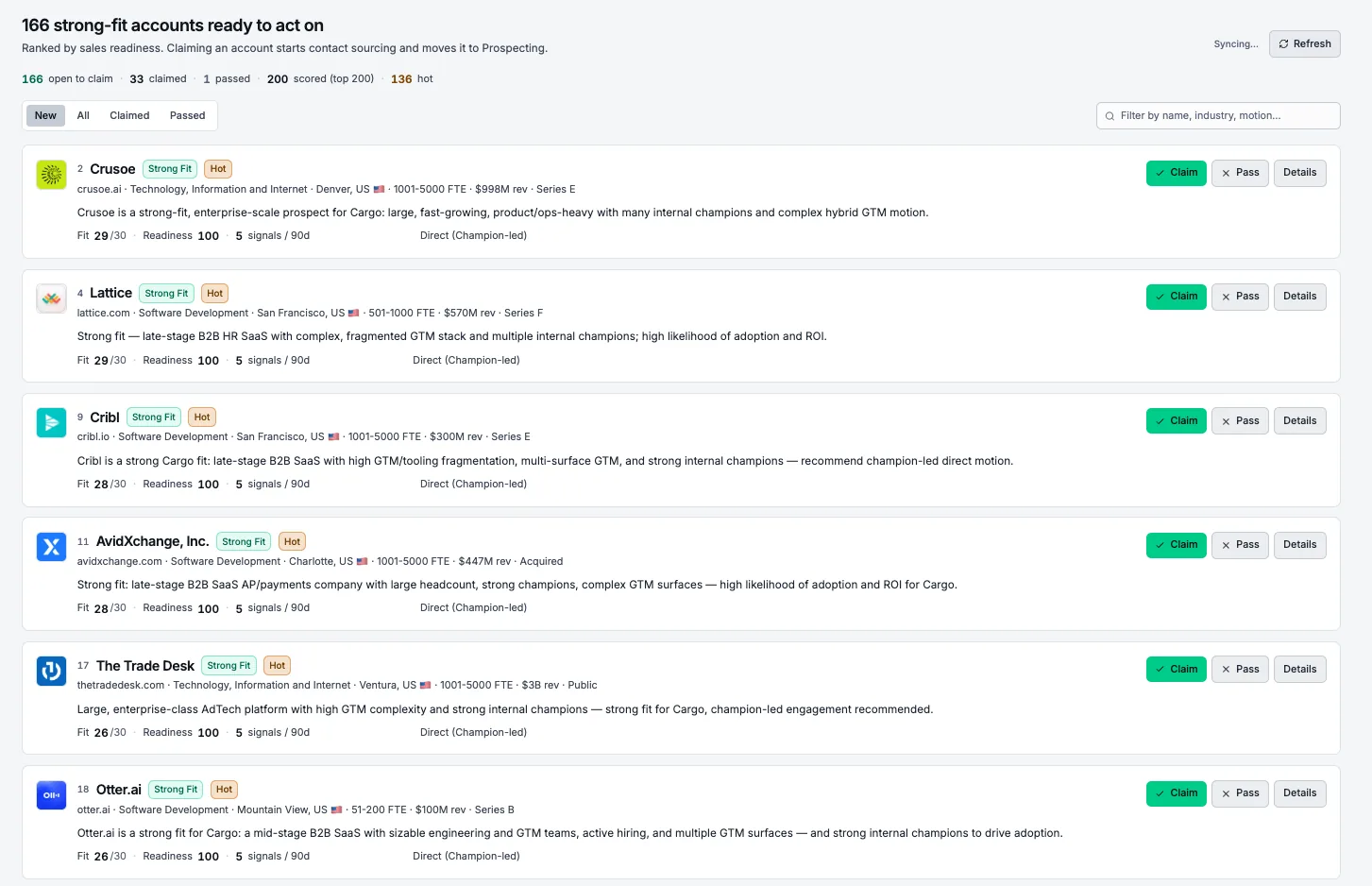
Every Monday, an agent refreshes our public jobs board and opens the GitHub pull request itself; a human merges it. Our entire market, 13,000+ accounts, is continuously rescored against live buying signals, and the cockpit surfaces the strong-fit accounts that deserve sales effort: 166 of them as I write this.
The live proof: a non-engineer built an enrichment play in six days #
The receipt that matters most is not on the feature list.
Earlier this month, a commercial operator with no engineering background, after two years of running everything through a spreadsheet-style enrichment tool, sat through one working session on Cargo. Six days after first seeing the platform, they were on the tenth version of a CRM enrichment workflow spanning tens of thousands of contacts, plus a first version of a Chrome extension for their reps, built on their own, at night, through Claude Code driving the Cargo CLI.
Their own read on the barrier is the part worth repeating: it was belief, not skill. The leap of faith, not the learning curve. The platform’s job was to make the leap land. The skills taught their agent the platform, typed errors told it what went wrong, and the traces showed them what their engine was actually doing while they learned.
One operator is one operator, and they had a working session with us before the solo run. But the shape of the story is the chain above in miniature: the agent supplied the engineering, and the platform supplied everything the agent needed to do real work without one.
What agents cannot do on Cargo yet #
The honest section, because a page like this one is worthless without it.
Repair is a pattern you set up, not a default. Traces, alerts and evaluators ship out of the box. The agent that acts on what they surface is one you configure. Nothing repairs itself until you wire it, and we say so.
Agents open pull requests. Merging is a human gate by default. The coding capability ends at a PR a person reviews. Low-risk classes of work can earn auto-merge under an explicit, revocable policy, the way our own engine runs, but anything that changes the engine or reaches a customer keeps a human on the button.
An agent cannot grant itself access. MCP authorization is a human OAuth grant, listed and revocable. An agent operates with the access a person gave it, under the permissions of that grant.
Long-running work is asynchronous past five minutes. Synchronous execution holds a request up to five minutes; beyond that, the agent polls the operation like any other engineer’s client would.
Two of these are limits that will move. Two are gates that move only when you explicitly decide they should. Knowing which is which is exactly the kind of thing a platform owes the people, and the agents, that operate it.
How to test any GTM platform for agent-readiness #
Eight questions, one per link in the chain, applicable to any vendor including us. Ask them with the documentation open.
| Test | What to look for |
|---|---|
| Is the system expressible as code? | The whole workspace declared in files, a plan step that shows the diff |
| Can a failed call be retried safely? | Idempotency keys on mutations, typed error bodies, stable operation IDs |
| Can the agent read system state directly? | One queryable source of truth, state diffing, entity history, no row caps |
| Is the business context readable and versioned? | ICP, personas and positioning as content an agent reads, with history |
| Can a mistake be reversed? | Versions on everything, diffs before deploy, rollback |
| Can you see afterwards what the agent did? | Per-run traces with steps, status and cost, evaluators, alerts on failures |
| When something breaks, can an agent help fix it? | A path from surfaced defect to proposed fix to human-reviewed change |
| Does the platform run agents, or only take calls? | Memory across runs, attached knowledge, output grading, delegation that ships |
A platform that passes all eight can be handed the operating loop with a clear conscience. A platform that passes two can be called by an agent, which is not the same thing.
Access vs architecture #
Every GTM tool now bolts MCP onto a product designed for humans. That grants agents access, and access is real: the agent can call things.
Cargo is architecture: state, context, actions, versioning and observability designed together, so that an agent can own the operating loop and a human can audit every decision it made.
Which is why the durable claim is not “our agent is better.” Agents are the interchangeable part of the stack; models leapfrog each other every quarter, and any platform that survives will let you swap them freely. The agents will change again next year. The engine underneath them is the asset: own it, version it, keep it repairable.
That is what Cargo is for.
Frequently asked questions #
An agent operates well where its environment is legible, safe, and self-correcting, in the agent’s native medium: code. Concretely, an agent-ready GTM platform offers typed read and write access to one canonical state, errors an agent can branch on, idempotent retries, business context stored as versioned content the agent reads, changes made through reviewable code with a plan step and rollback, per-run traces of everything that executed, and a path for an agent to propose fixes a human reviews. An API or MCP endpoint alone establishes access, not operability.
Yes. Claude, ChatGPT and Cursor authorize against Cargo directly over OAuth and reach the platform through Cargo’s hosted MCP server, with every connected app listed and revocable. Coding agents can also work through the Cargo CLI and its skill bundle, which is how most of the heavier build work happens in practice.
Cargo’s skill bundle installs with npx skills add getcargohq/cargo-skills, and account creation plus sign-in run headless, with the email and one-time code passed as environment variables. Both getcargo.ai and docs.getcargo.ai serve an llms-full.txt file, so the agent can load the full documentation surface in a single request before it starts.
Four honest answers. Self-repair is a pattern you configure on top of traces and evaluators, not a default behavior. Agents open pull requests but do not merge them by default; low-risk classes can earn auto-merge under an explicit policy, and anything that changes the engine or reaches a customer keeps a human review. An agent cannot grant itself access; MCP authorization is a human OAuth grant. And synchronous execution caps at five minutes, after which the agent polls the operation asynchronously. Two of these are limits that will move, two are gates that move only by your explicit decision.
Through the same surfaces an engineering team uses for production software. Every run the agent triggers leaves a trace with steps, status and cost. Alerts fire on failing steps, failing runs, or SQL conditions against the warehouse. Evaluators grade agent output and gate what passes. Structural changes arrive as pull requests a person reviews. The supervision is in the system, not in watching the agent type.
Because agents retry, and agents cannot see the screen. An idempotency key makes a retry after a timeout safe: the platform recognizes the repeated request and does not run the action twice, which is what prevents an agent from double-sending or double-spending on a network blip. Typed error bodies turn a failure into data the agent can branch on, instead of prose it has to guess about. Together they are most of the difference between an agent you can trust with writes and one you can only trust with reads.
 MaxAug 26, 2026