The Comprehensive Guide to TAM Prioritization

You have identified and centralized your Total Addressable Market.
Now, it’s time to take action.
Sales reps often find themselves in a conundrum: where to focus their time and energy for maximum impact.
According to Chet Holmes, only 3% of any market actively seeks solutions, while 40% might consider switching solutions.
So, how do you navigate and identify who to target in the 97% who aren’t actively shopping?
 Salesforce 5th State of Sales report
Unsurprisingly, prioritizing opportunities is one of the most time-consuming tasks for sales reps, according to the Salesforce State of Sales study (Must read!)
Here are three proven strategies to segment your Total Addressable Market effectively:
-
Industry Verticals: Focus on sectors with high win rates.
-
Intent Scores: Leverage B2B signals or intent indicators.
-
Scoring Models: Utilize ICP (Ideal Customer Profile) and behavioral criteria **to detect which accounts/leads should be engaged
Let’s jump in.
1. Industry-Based Targeting: The Classic Yet Effective Approach #
The industry-based prioritization strategy is simple and effective.
The strategy: #
To start, perform a win/loss analysis to pinpoint the most promising industries where your closing rate or sales velocity is above average.
The main advantage of this approach is the ability to align sales & marketing to craft a coherent end-to-end journey.
Secondly, as you choose whom to target, you can personalize your approach according to the company size, industry, and use case, ensuring resonance and relevancy.
The icing on the cake?
Prospect journeys with a mix of Marketing and sales touchpoints have a higher chance to be signed and a shorter sales cycle, as well as fewer sales touchpoints needed before converting into opportunity. More concretely, from my experience, I noticed that (analysis made on 700 accounts outreached over one year):
-
Full sales journey type has the lowest win rate at 23%, while mixed initiated with marketing has the highest win rate as 39%.
-
On average, Mixed initiated with Marketing prospects take 13 days less to win than full sales one
-
Number of sales touchpoint needed before opportunity creation for full sales prospect type is 7, half of what needed for mixed initiated with marketing prospect type one which is 3.
Last but not least? this strategy is repeatable: You can scale it to all top-performing industries and segments.
How to identify the right industry? #
Two steps:
-
Win/Loss Analysis: In your CRM, generate a report covering the last 6-12 months’ opportunities and categorize them by deal status (closed-lost, closed-won, etc.). You will distribute that information by industry (see below)
-
Market Depth Assessment: Evaluate the market depth of each industry in relation to your CRM records to gauge the opportunity size.
⇒ By understanding this information, you can direct your attention toward segments performing well and having a significant volume to target them legitimately.
 Win/loss analyis
How to target your chosen industry? #
Here are the main steps to follow for a typical cohesive “all-bound” journey mixing sales & marketing touchpoints:
-
Audience: Identify the accounts you want to address in your TAM (or PRM).
-
Pre-targeting: Run ads to this set of accounts before reaching out to them. It will boost open rates, response rates, and overall outbound performances.
==> Awareness: Target multiple stakeholders within an account with social ads to promote valuable resources such as ebooks, videos, webinars, or collective demos (with a lead gen form). Pro tip: Use LinkedIn Matched Audience for this
==> Consideration: Create retargeting campaigns to move your leads toward the bottom of the sales funnel.
 Linkedin retargeting
LinkedIn allows you to retarget leads who interacted with your awareness campaign using different options based on content format or sources.
-
Sales outreach: Qualify the account with a bottom-up strategy and secure internal referrals to decision-makers.
-
Nurturing (optional): Nurture campaign work leads until they’re ready to buy. SalesLoft AEs have closed 30% of accounts using this strategy. The most effective combines timely sales follow-ups with industry-specific content (see below)
 Content performances
2. Intent-Based Strategies: The Power of B2B Signals #
An intent or buying signal is an event we identified as a good momentum to contact a company.
The Strategy: #
Think of it like an automated engine that empowers sales reps with qualified leads that convert the best.
During my time at Spendesk, the timing was among the top lost reasons in our CRM. If you can calibrate the right timing to reach an account, you start with an unfair advantage and a better chance to convert your prospect.
Intents allow you to contact companies with a targeted message at the most opportune time, leading to higher reply and conversion rates. Typically, we noticed 3X more conversions on an account with intents vs. the average.
it’s also a way to personalize your copy at scale based on the specific momentum. You can also anticipate company challenges more easily. For instance, say a company is fundraising; you know it involves structuring the company, hiring new people, and implementing processes to support company growth.
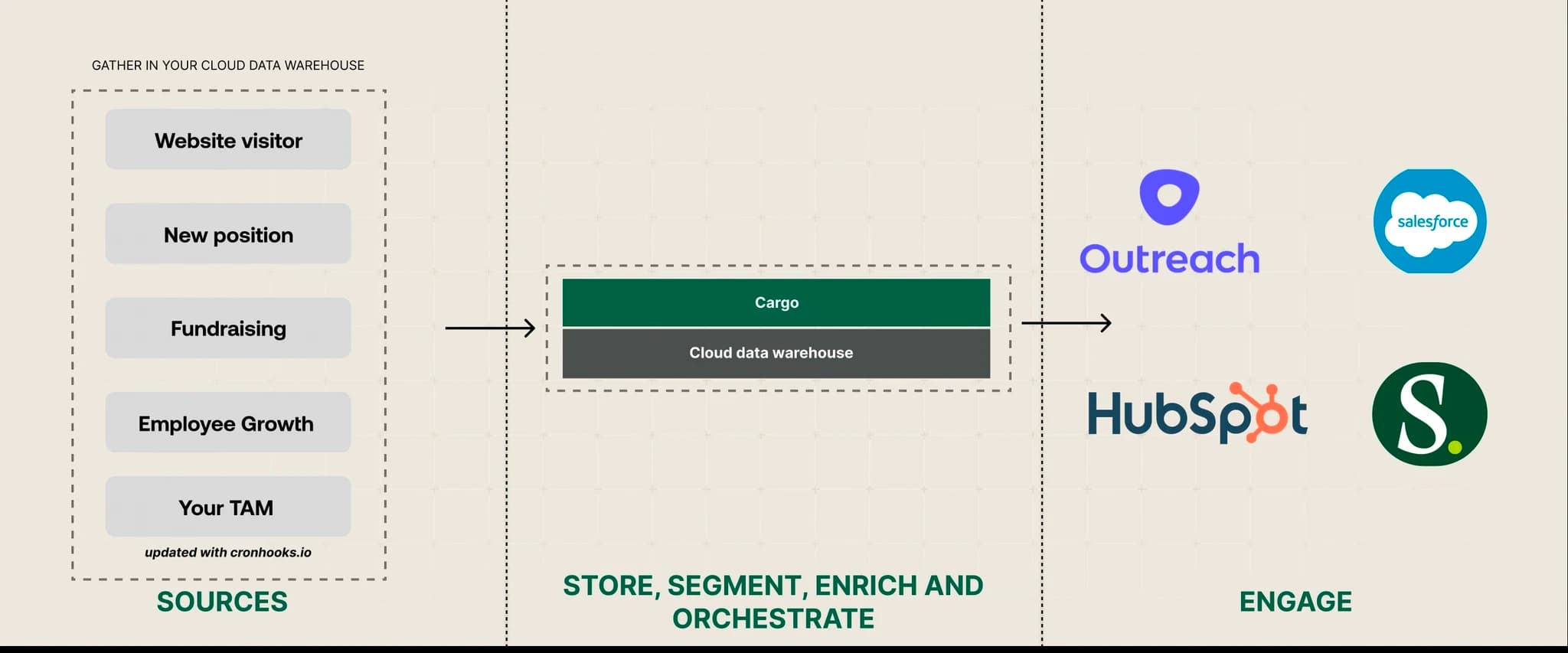 PRM
Common Buying Signals #
Free gift: Intent Matrix
Account signals:
-
Fundraising activities
-
Employee growth
-
Tech stack changes
-
Web traffic spikes
-
Website visitor
-
Common VCs
Contact signals:
-
Behavioral triggers from your first-party data (saw pricing page, downloaded content, attended webinars)
Bref, you got the idea!
This involves creating a dedicated sequence per intent (or at least sequence snippets) that your sales reps can use to scale their outreach effort.
See below an example we’ve used on the champion’s intent.
 champions
Intent
Something worth mentioning is that intents not only populate new leads into your CRM but also reactivate closed-lost accounts in a relevant way.
How to find signals worth tracking? #
-
JTBD / Qualification framework: Either you conduct Jobs-to-be-Done (JTBD) interviews to understand the precise context of the purchase triggers of your prospects. Or, you could listen to your sales reps’ qualification call recordings to understand the prospect’s mindset when purchasing + analyze close-won customers.
-
Do tests that don’t scale: Kickstart the project with some ad-hoc scrapping for B2B signals. Once you validate the assumptions, then you can scale it.
-
Custom Object: Once you’re ready to scale, creating a custom object to store those pieces of information in your CRM is a great attribution strategy
 Salesforce custom
Object
How to use it to build pipeline: #
-
Audience: New hire - Extract Linkedin or segment your audience in your B2B data providers or PRM (no scale so far)
-
CRM update: Upsert the data in your CRM/ You can scale personalization with the variable related to the momentum. In that case, it would be the
[previous_companyName] and [new_companyName]. -
Lead Assignment: Assign to the specific sales squad for this intent experiment.
-
Routing: Route to the specific sequences
-
Scale: Once everyone shows the uplift, you won’t have problems asking for time to make it systematic.
3. Scoring-Based Strategies: The Science of Sales #
The Strategy #
Have you ever heard of MQL or PQL?
These are methods to assess a lead’s maturity level, whether from a marketing, or product perspective.
Ultimately, you want to know how likely the lead is to become a customer and allocate sales efforts accordingly.
Often, it can be traced back to a scoring model.
The main advantage is its flexibility: You can evaluate how closely a lead or account aligns with your ideal customer profile or measure product activity that correlates with growth.
Basically, combining the two previous logic: weigh specific industry or B2B signals as part of your scoring model.
Here, I left you a freebie for reading this far: Scoring Template
It is best practice to have two separate scores: one for fit based on Ideal Customer Profile attributes and another for likelihood to buy based on behavioral data.
Sometimes, product-led sales companies use a scoring model for each playbook in the flywheel model framework instead of a global fit or PQL score.
 Scoring leads in
Cargo
Whether it’s about mastering your scoring model or streamlining your lead routing process, Cargo is there to lend a hand.
Decoding the Score #
Ultimately, score ranges are labeled to be easily understood by end users, as just a number won’t be meaningful for sales or marketing folks.
 Scoring leads in
Cargo
How to execute your scoring framework #
-
Define Criteria: Establish what constitutes a high fit or high intent score.
-
Scoring Model: Implement the scoring model in your orchestration tool
-
Labeling: Use easily understandable labels for score ranges.
Prioritizing your TAM doesn’t have to be a daunting task. Start simple with one of the frameworks above.
And once you’re comfortable and begin to be nostalgic of the future, mix it up. Observe the illustration below. This was how I did it at Spendesk.
 Outbound intent based strategy
In such a way, you employ a mix of industry-based, intent-based, and scoring-based strategies, to confidently navigate the complex landscape of sales opportunities and drastically improve your outbound performances.
For the next article in this series, we will talk about how to nail outbound outreach.
Read the EPISODE 3 on how to nail outbound outreach
Key Takeaways #
- Only 3% of any market actively seeks solutions: According to Chet Holmes, while 40% might consider switching, the challenge is identifying and prioritizing the 97% who aren’t actively shopping, making TAM prioritization critical for sales efficiency
- Three proven prioritization strategies work best: Industry-based targeting (focus on high win-rate sectors), intent-based strategies (leverage B2B signals for 3x conversion rates), scoring-based strategies (combine ICP fit + behavioral likelihood to buy), each can work alone or combined
- Mixed marketing + sales journeys win 39% vs 23% sales-only: Prospects with both marketing and sales touchpoints have highest win rates (39% vs 23%), take 13 days less to close, and need only 3 sales touchpoints vs 7 for sales-only approaches
- Intent signals provide 3x conversion uplift: Accounts with buying signals (fundraising, new hires, tech stack changes, job postings) convert 3x better than average, timing is among top lost reasons, so catching the right moment creates unfair advantage
- Separate fit score from intent score: Best practice is two scores, ICP fit score (company size, industry, tech stack) and behavioral intent score (product usage, engagement, signals), combining both enables precise prioritization and routing
Frequently Asked Questions #
TAM (Total Addressable Market) prioritization is the process of segmenting and ranking your entire addressable market to focus sales efforts on accounts most likely to convert.
The core problem: Only 3% of any market actively seeks solutions (Chet Holmes), while 40% might consider switching. Without prioritization, reps waste time on low-probability accounts instead of focusing on high-intent opportunities.
Impact of effective prioritization:
- 39% win rate (mixed marketing + sales) vs 23% (sales-only)
- 13 days faster sales cycles
- 3 sales touchpoints needed vs 7
- Better resource allocation and rep productivity
Industry-based targeting focuses on specific industries/verticals where your win rates and sales velocity are above average.
Implementation steps:
1. Win/Loss Analysis: Pull 6-12 months of CRM data, calculate win rate by industry, identify industries with > 30% win rate
2. Market Depth Assessment: Evaluate TAM size in each high-performing industry to ensure sufficient volume
3. Build Allbound Journey:
- Pre-targeting: Run LinkedIn ads to target accounts before outreach
- Retargeting: Create campaigns for engaged accounts with case studies and ROI calculators
- Sales Outreach: Qualify accounts with personalized, industry-specific messaging
- Nurturing: Automated campaigns for not-yet-ready accounts (SalesLoft AEs closed 30% using this)
Result: Repeatable, scalable approach with higher conversion (39% vs 23%) and shorter sales cycles
Intent signals are events indicating a company is in-market or experiencing change that creates buying opportunity. Accounts with intent signals convert 3x better than average.
Common signals:
Account-level: Fundraising activities, employee growth (> 20% in 6 months), job postings for key roles, tech stack changes, web traffic spikes, pricing page visits
Contact-level: New hires (champions joining new companies), job changes/promotions, behavioral triggers (content downloads, webinar attendance)
Implementation:
- Conduct JTBD interviews and analyze closed-won customers to identify relevant signals
- Start with manual tests to validate assumptions
- Scale with Salesforce custom objects to track signals
- Build dedicated sequences per signal type with personalized messaging
Result: 3x conversion rate on accounts with intent signals vs cold outreach
Scoring-based prioritization uses quantitative models to assess likelihood to convert. Best practice: maintain two separate scores.
Score 1: ICP Fit Score (Firmographic)
- Based on: Company size, industry, tech stack, geography, revenue
- Example criteria: 100-500 employees (20 pts), SaaS/FinTech (15 pts), uses Salesforce (10 pts)
Score 2: Intent Score (Behavioral)
- Based on: Product usage, website visits, content engagement, intent signals
- Example criteria: Active trial user (25 pts), pricing page visit (15 pts), fundraising signal (20 pts)
Routing logic:
- High fit + High intent = Tier 1 (immediate AE assignment)
- High fit + Warm intent = Tier 2 (SDR qualification)
- High/Medium fit + Low intent = Nurture
- Low fit = Disqualify
Free resource: Scoring Template Spreadsheet
The most effective approach layers all three strategies:
Layer 1: Industry-Based Foundation Start with win/loss analysis to identify top-performing industries (> 30% win rate)
Layer 2: Scoring-Based Segmentation Apply ICP fit scoring to all accounts in target industries, segment into A/B/C tiers
Layer 3: Intent-Based Activation Monitor A/B tier accounts for intent signals, calculate intent score, route based on combined scores
Practical example: Focus on SaaS vertical (35% win rate) → Score 5,000 companies → Focus on 3,500 A/B tier accounts → Monitor for signals → Route to appropriate tier
Expected results by tier:
- Tier 1 (A fit + Hot intent): 40-50% win rate, 60-day cycle, 3 touchpoints
- Tier 2 (A fit + Warm intent): 20-30% win rate, 90-day cycle, 5 touchpoints
- Tier 3 (A/B fit + Cold intent): 5-10% win rate, 120-day cycle, 10+ touchpoints
Minimum Viable Stack (~$2K-3K/month):
- Data warehouse: Snowflake or BigQuery (free tier available)
- Orchestration: Cargo (routing and automation)
- CRM: Salesforce or HubSpot (store scores and attribution)
- Intent providers: UserGems (champion tracking) + RB2B (website visitors)
- Enrichment: Cargo (waterfall enrichment for firmographic data)
Additional tools for scale:
- ETL: Fivetran or Airbyte (data ingestion)
- Transformation: dbt (scoring calculations)
- Marketing automation: Marketo or HubSpot (nurture campaigns)
- Sales engagement: Outreach or Salesloft (outreach sequences)
- Analytics: Looker or Tableau (performance tracking)
Implementation timeline: 3-6 months from setup to full optimization
ROI: Teams typically see 2-3x improvement in win rates on prioritized accounts within 6 months