Salesforce has been considered for a long time as the source of truth. However, in the last 5 years, the number of SaaS tools used by companies has been multiplied by 10. Data are disparate across more tools than it was before (analytics data, product data, marketing data, financial data …) and Salesforce became less and less the reference for business and customer data.
The first generation of tools called CDPs tried to solve these problems.
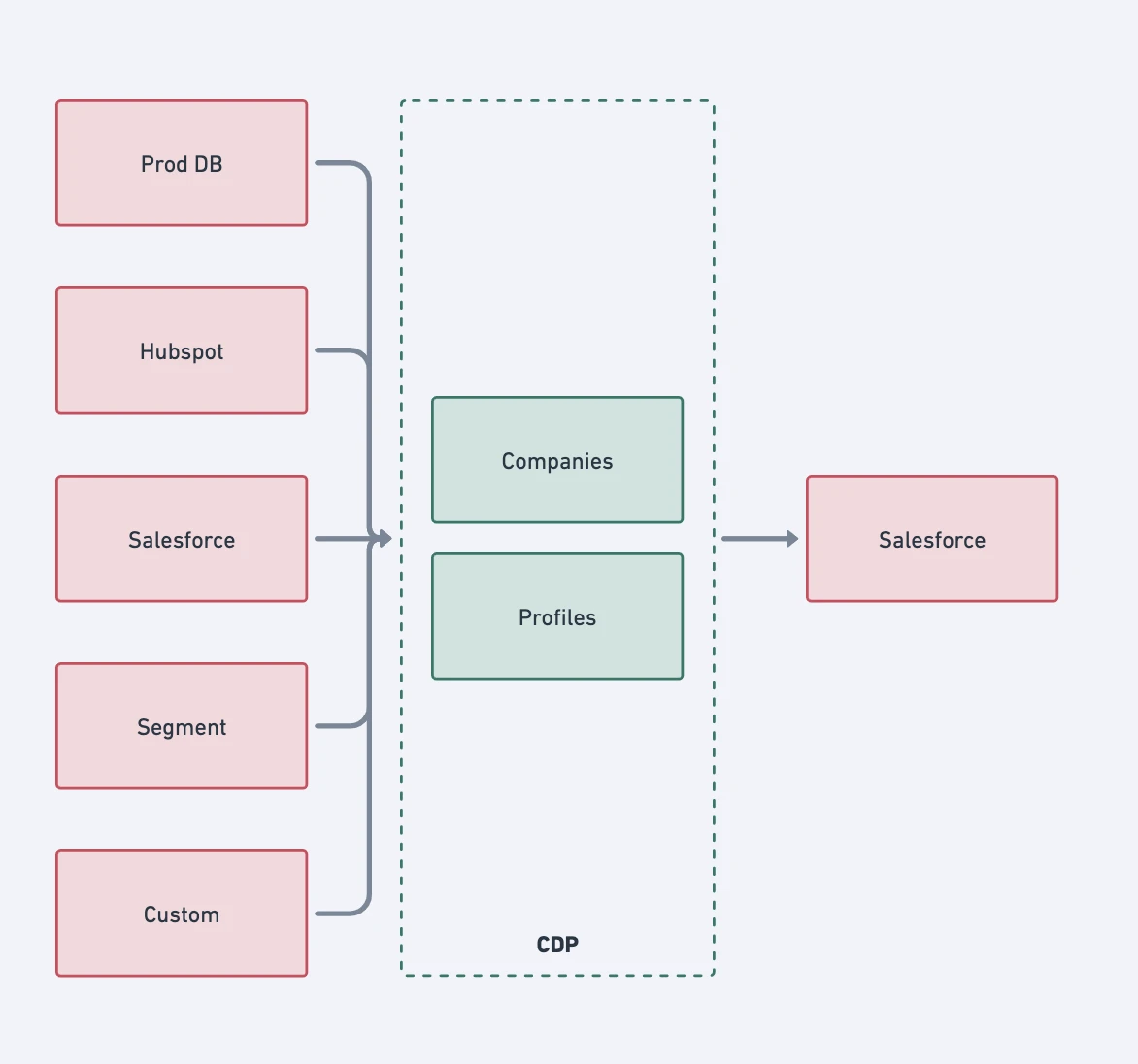
Their main value proposition was simple: Reconsolidate data (mainly analytics data and customer data) to have a clear overview of the customer journeys and sync them back into your company’s CRM.
They were promising to own the source of truth again. But they actually made the same mistake than CRMs did. They couldn’t easily adapt and fit the data complexity of your organization. You ended up with an infinite loop, data you couldn’t unmerge and automatic workflows you couldn’t control.
The second generation of tools called Reverse ETL tackled the problem in a smarter way taking advantage of the rise of cloud data warehouse adoption.
As the data warehouse was becoming central in companies for data visualization, they leveraged the work done by analytics engineers to sync it back into your CRM.
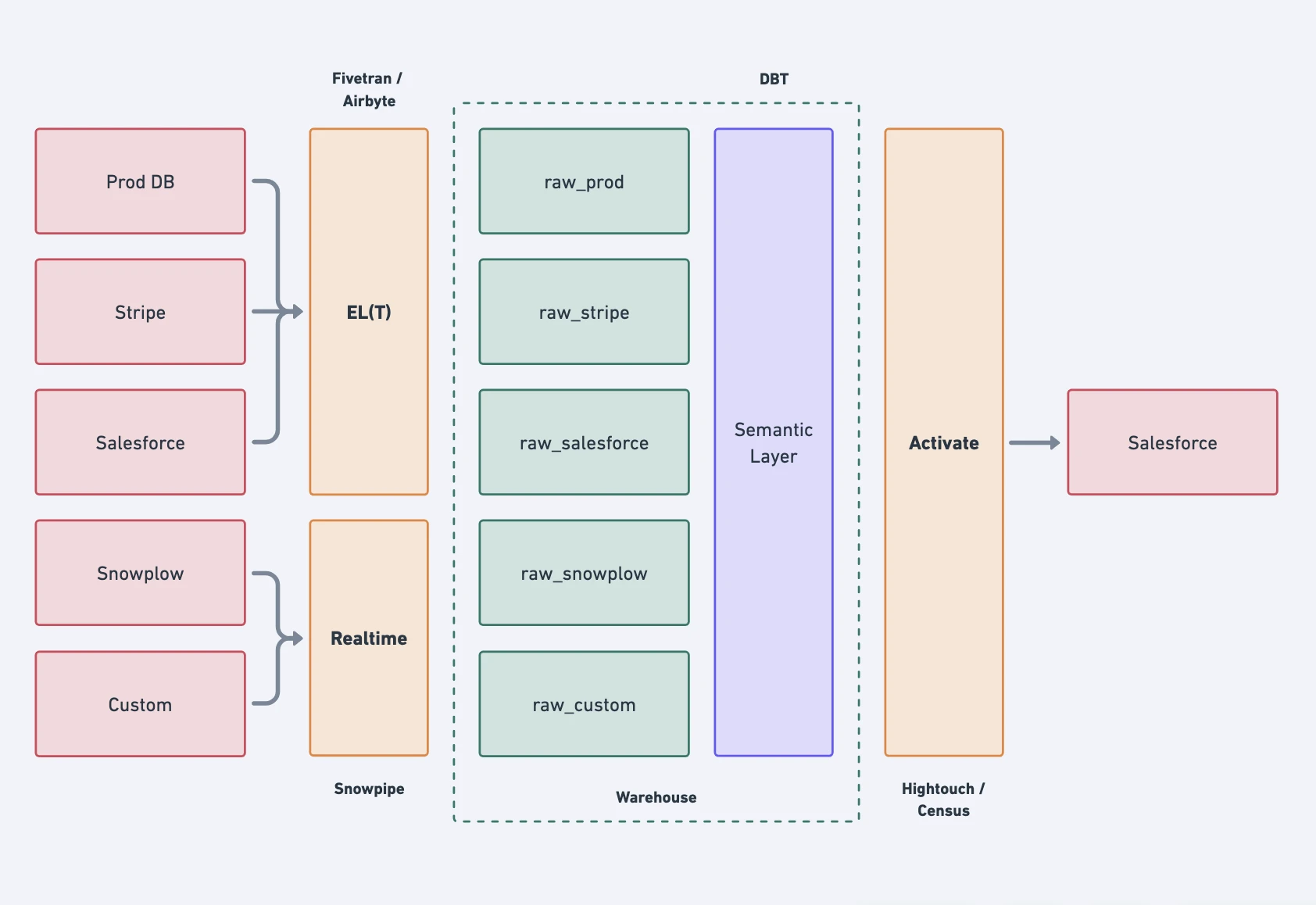
But finally, if we step back, what are these 2 tool categories are trying to do? … They are just patching CRM limitations.
Let’s list some of these limitations here:
-
Opinionated - CRMs enforce a proprietary data model to represent your business entities and you will have to hack it to match your own definition or push other than customer or sales data
-
Inflexible - Models can’t be easily recomputed as your organization grows. You have to be cautious when starting to build your CRM properly otherwise you’ll end up with messy and unusable data and have to start again from the beginning
-
Locked up - APIs were great for the old world but limited when we are talking about synchronizing/updating a big amount of data. Data is managed and owned by our CRM and can’t be easily accessible for other providers/services.
And who is the best applicant to solve all these limitations? … Your data warehouse. Instead of trying to push it and format it in another tool you don’t master/control. Why not just use these models you or your team built while remaining in the warehouse.
That’s why we truly believe that the data warehouse and especially Snowflake is going to be a dangerous competitor for Salesforce in the coming years.
And both of them know their strengths and weaknesses. Snowflake owns the data and Salesforce, the sales interface. On one side, Salesforce signed a partnership for easy data sharing. On the other side, Snowflake announced the launch of Unistore and the Native Application Framework that show their interest in not only being considered as a data warehouse anymore.
Their ambition is to become a data operation system with a marketplace and to define a new standard for software to communicate together and access the data.
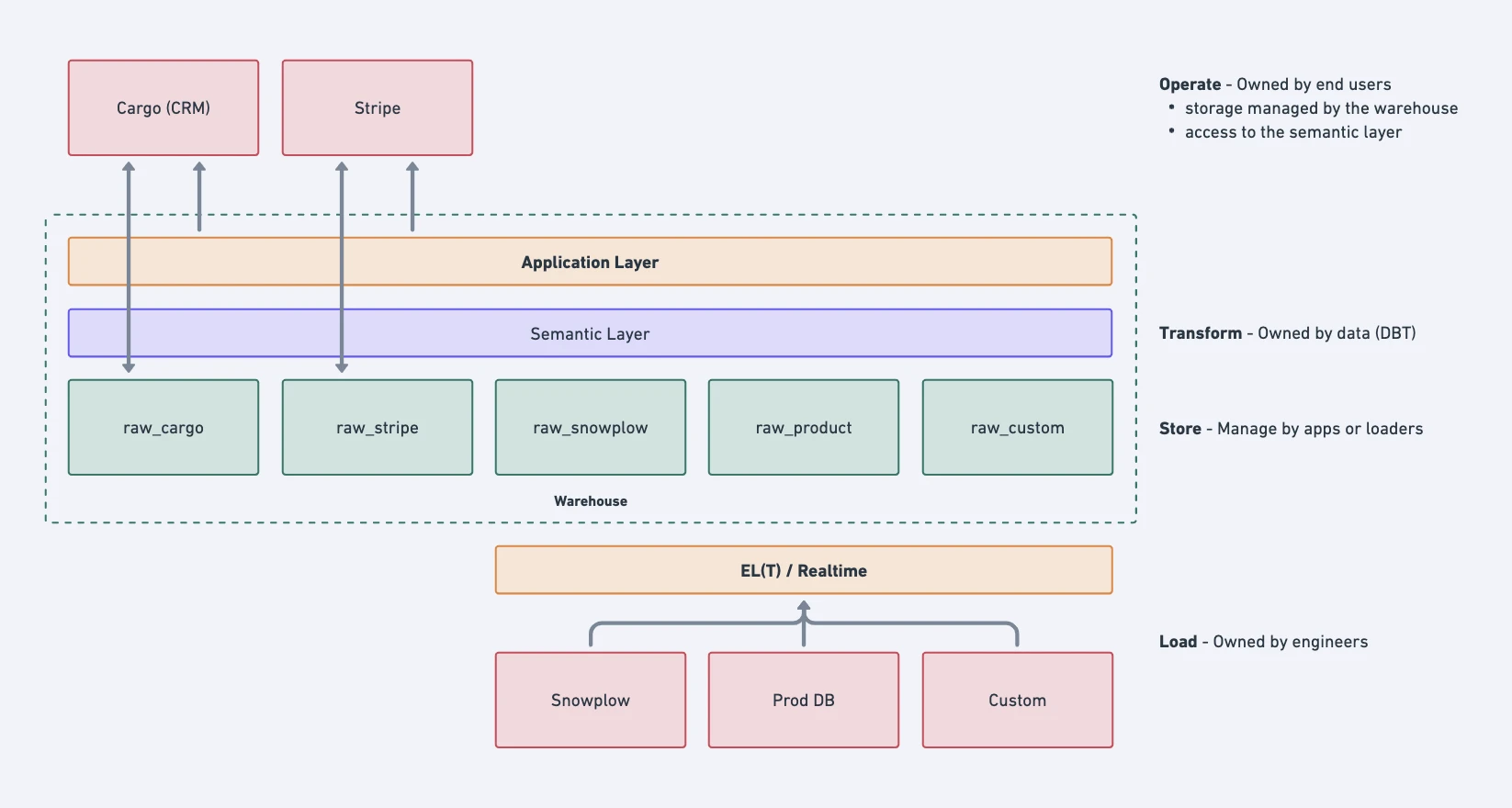
Semantic layer will become a new standard for SaaS apps to communicate together. Data engineering will provide a unified data business layer that apps could consume. APIs won’t be necessary anymore to sync data between tools. SaaS tools read and write data in the data warehouse and won’t own your data.
CRM was the first software to be a SaaS, it was the first software to own a marketplace, and the first software to provide a public API.
We can split a CRM into two main functions: the system of record, how you catalogue all the related customer data in a single place, and the system of engagement, helping you to interact with your customers.
The warehouse is where the records live. Cargo is the GTM system of record on that warehouse: companies, contacts, deals and custom objects that agents and plays create, update and unify. The CRM becomes the engagement layer — the place reps work, synced a curated slice of that truth — not the source of truth, and not the product Cargo is.
Key Takeaways #
- Salesforce lost “system of record” status as SaaS proliferated: 10x more tools in 5 years fragmented data across analytics, product, marketing, finance, CRM became one source among many, not THE source of truth
- Two generations tried patching CRM limitations: CDPs (1st gen) reconsolidated data but repeated CRM mistakes (inflexible, locked); Reverse ETL (2nd gen) leveraged data warehouses smartly, but both just patch CRM’s opinionated, inflexible, locked-up architecture
- Three core CRM limitations data warehouses solve: Opinionated (enforces proprietary data model vs. your business entities), Inflexible (models can’t recompute as org grows, messy data requires restart), Locked (APIs slow for bulk sync, vendor owns data)
- Snowflake’s ambition: become data operating system with marketplace: Unistore + Native Application Framework position Snowflake beyond warehouse, semantic layer as new standard for SaaS communication (apps read/write directly to warehouse, no APIs needed)
- Future GTM = System of Record (Cargo, stored in the warehouse) + System of Engagement (CRM): Snowflake/BigQuery hold the data; Cargo is the GTM system of record that lives there (writable models, unification, agents and plays that write records). Salesforce/HubSpot stay the sales interface, synced a curated slice, not the source of truth.
Frequently Asked Questions #
Salesforce was the original system of record when it was the only major SaaS tool. But in the last 5 years, companies adopted 10x more SaaS tools, separate systems for product analytics, marketing automation, customer success, finance, enrichment, and more. Data became distributed across these tools, and Salesforce became just one data source among many, not THE authoritative source of truth. Customer data, sales data, product data, and behavioral data all lived in different systems, making it impossible for any CRM to claim “system of record” status.
First generation (CDPs like Segment): Attempted to reconsolidate customer and analytics data into one place, then sync back to CRM. Promised to restore “single source of truth.” Failed because they repeated CRM mistakes, became inflexible, created data you couldn’t unmerge, built automatic workflows you couldn’t control.
Second generation (Reverse ETL like Hightouch, Census): Smarter approach leveraging cloud data warehouses. Instead of creating another data silo, they synced warehouse data (already unified by analytics engineers) back to operational tools like CRM. This worked better but was still “patching CRM limitations” rather than solving root problem.
1. Opinionated: CRMs enforce a rigid data model (Lead, Contact, Account, Opportunity objects) that doesn’t match your actual business entities. You’re forced to hack it to represent your business (What’s a Workspace? A Team? A Donor?). Warehouses let you define entities that match your business exactly.
2. Inflexible: CRM data models can’t easily recompute as your organization grows. Once set, changing them is painful, leads to messy, unusable data, often requiring full restart. Warehouses use SQL transformations (dbt) that can reprocess all historical data with model changes.
3. Locked up: APIs were fine for syncing small amounts of data but are slow/limited for bulk operations. Your data is managed and owned by CRM vendor, not easily accessible. Warehouses give you complete data ownership and control.
Snowflake is positioning itself as a “data operating system” with a marketplace, not just a warehouse:
Unistore: Hybrid transactional/analytical database, handles operational workloads (like CRM writes) alongside analytics.
Native Application Framework: Lets developers build apps that run directly on customer data in Snowflake, app code ships to data, not data to app. Creates Snowflake marketplace similar to Salesforce AppExchange.
Semantic layer vision: SaaS apps would read/write data directly to/from warehouse via unified business layer built by data engineers. APIs become unnecessary, tools don’t “own” data, they just interface with warehouse.
Salesforce partnership: Both companies acknowledge the shift, Snowflake owns data, Salesforce owns interface. Partnership enables easy data sharing between them.
Future GTM splits into two layers:
System of Record (Cargo, stored in the warehouse): Snowflake/BigQuery is the store. Cargo is the GTM system of record on it: companies, contacts, deals and custom objects, created and updated by plays and agents, unified across sources, queryable with SQL. That is the authoritative GTM source of truth. Cargo is not a read-only overlay and does not “not own” the data.
System of Engagement (CRM): Salesforce/HubSpot remain the place reps work. Cargo syncs a curated slice out. The CRM is not the source of truth.
SaaS Apps: Consume data via semantic layer, unified business logic built once, consumed by all tools. Apps become interchangeable interfaces to your data rather than proprietary data silos.
Result: You own the data, tools are swappable, no vendor lock-in, complete flexibility to model the business your way.
Join the movement 👉 https://www.getcargo.ai
 AurelienMar 31, 2025